Security Didn’t Fail — Confidence Did
Every major data breach leaves behind more than exposed records.
It leaves doubt.
Doubt in systems.
Doubt in brands.
Doubt in whether anyone is truly in control.
Despite billions spent on cybersecurity tools, organizations are losing something far harder to replace: trust.
Customers hesitate before sharing data.
Employees question internal systems.
Partners demand more proof, more audits, more assurances.
This shift signals something profound.
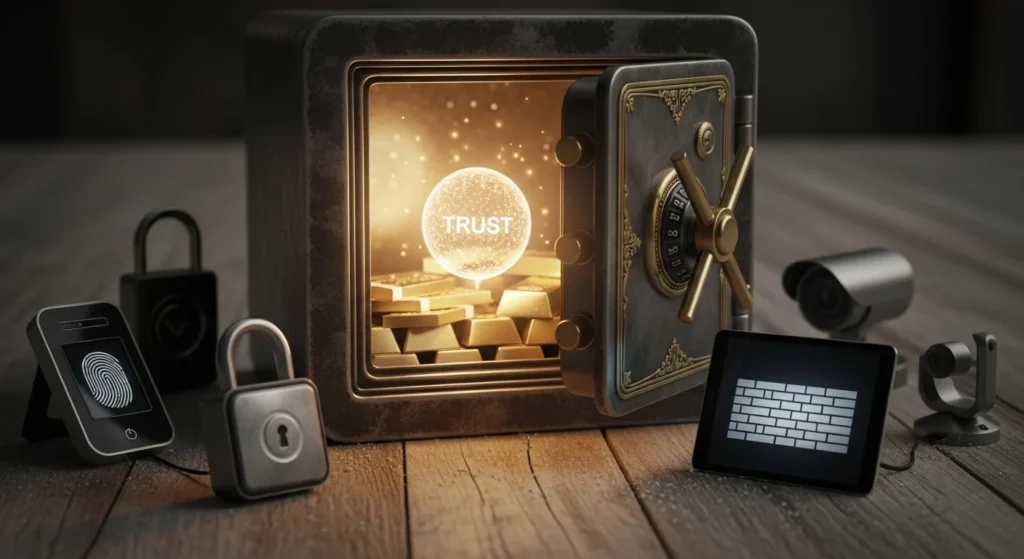
In the modern digital world, trust is becoming the most valuable security currency — one that determines who gets access, loyalty, growth, and long-term survival.
Technology can block attacks.
Only trust can sustain relationships after them.
What “Trust as a Security Currency” Really Means
Trust in cybersecurity isn’t about blind belief.
It’s about verifiable confidence.
Today, trust is earned when organizations consistently prove they can:
- Protect data responsibly
- Detect threats early
- Respond transparently
- Respect user privacy
- Recover without hiding the truth
This form of trust behaves like currency:
- It accumulates through good decisions
- It depreciates after breaches or deception
- It can be spent during crises
- Once lost, it’s extremely expensive to regain
In short, trust determines whether people stay, leave, or never engage at all.
Why Traditional Security No Longer Creates Trust
For decades, security focused on defenses:
- Firewalls
- Antivirus software
- Perimeter-based controls
- Complex passwords
These measures still matter.
But they no longer convince users that systems are safe.
Why?
Because most modern breaches happen inside trusted environments:
- Compromised credentials
- Insider threats
- Third-party vendors
- Misconfigurations
- Over-permissioned users
From the outside, everything looked secure.
From the inside, trust was misplaced.
The Shift From “Secure Enough” to “Trustworthy Always”
Modern users don’t ask:
“Is this system secure?”
They ask:
“Can I trust you with my data tomorrow, not just today?”
This is why leading organizations are shifting toward:
- Continuous verification
- Transparency over secrecy
- Accountability over compliance checklists
- User-centric security decisions
Trust isn’t assumed.
It’s continuously earned.
Zero Trust Didn’t Eliminate Trust — It Redefined It
The rise of Zero Trust security models is often misunderstood.
Zero Trust doesn’t mean trust no one forever.
It means:
- Never trust by default
- Always verify context
- Continuously validate identity, behavior, and risk
This approach reflects reality.
People change.
Devices get compromised.
Access needs evolve.
Trust becomes dynamic, not static.
Trust as a Business Asset, Not Just a Security Feature
Trust directly impacts:
- Customer retention
- Brand valuation
- Regulatory scrutiny
- Partner relationships
- Employee morale
Consider this pattern:
- Two companies suffer similar breaches
- One communicates quickly, honestly, and responsibly
- The other delays, deflects, or minimizes
Only one recovers public confidence.
The difference isn’t the breach.
It’s how trust was handled.
Real-World Examples of Trust as Security Currency
Example 1: Transparency After a Breach
When companies like Microsoft publicly document vulnerabilities, patch timelines, and lessons learned, they demonstrate maturity.
Customers may not like the incident — but they trust the response.
Example 2: Privacy as a Trust Signal
Apple built its security reputation by turning privacy into a visible promise.
Not perfect security — but visible respect for user data.
That distinction matters.
How Trust Changes Security Decision-Making
When trust becomes the goal, organizations start asking different questions:
- Should we collect this data at all?
- Do users understand how their data is used?
- Can access be reduced instead of expanded?
- What happens when—not if—something fails?
Security stops being about control.
It becomes about responsibility.
Trust vs Traditional Security: A Comparison
| Traditional Security Focus | Trust-Centered Security |
|---|---|
| Perimeter defense | Continuous verification |
| Tool-heavy | Principle-driven |
| Compliance-driven | Accountability-driven |
| Silent after breaches | Transparent communication |
| User friction tolerated | User trust prioritized |
| Reactive | Proactive & adaptive |
This shift doesn’t remove tools.
It gives them purpose.
Why Trust Matters More Than Ever Today
Digital ecosystems are deeply interconnected.
Your security is affected by:
- Vendors
- APIs
- Cloud providers
- Contractors
- Supply chains
Trust now flows across boundaries.
One weak link damages everyone.
This is why regulators, customers, and partners increasingly demand proof, not promises.
Common Mistakes Organizations Make About Trust
1. Treating Trust as a PR Problem
Trust can’t be repaired with messaging alone.
It’s rebuilt through behavior.
2. Overcomplicating Security for Users
When systems frustrate users, they bypass controls.
Trust erodes silently.
3. Hiding Incidents to “Protect Reputation”
Delayed disclosure damages trust more than the breach itself.
4. Assuming Compliance Equals Trustworthiness
Passing audits doesn’t guarantee ethical or resilient security.
How to Build Trust-Centered Cybersecurity (Actionable Steps)
1. Design for Least Trust, Maximum Clarity
- Limit access by default
- Explain why access is denied
- Make security decisions understandable
2. Make Security Visible, Not Obstructive
- Clear alerts
- Simple explanations
- Predictable behavior
3. Invest in Detection and Response, Not Just Prevention
People trust systems that recover well, not just those that promise perfection.
4. Communicate Early, Clearly, and Honestly
Silence is interpreted as guilt or incompetence.
Hidden Insight: Trust Is What Scales Security
Technology scales linearly.
Trust scales exponentially.
A trusted organization:
- Faces fewer user workarounds
- Experiences faster incident recovery
- Receives more forgiveness after failure
- Attracts better partners and talent
This is why trust isn’t soft.
It’s strategic.
Key Takeaways
- Cybersecurity is shifting from tools to trust
- Trust acts like a renewable—but fragile—currency
- Zero Trust models redefine how trust is earned
- Transparency strengthens security outcomes
- Organizations that prioritize trust recover faster
- Trust-centric security scales better than fear-based control
Frequently Asked Questions
1. Is trust more important than security technology?
No. Trust depends on technology — but technology alone cannot create trust without responsible behavior.
2. How can organizations measure trust in cybersecurity?
Through user confidence, incident response perception, transparency metrics, and long-term engagement.
3. Does Zero Trust eliminate the need for trust?
It replaces assumed trust with continuously verified trust.
4. Can small organizations compete on trust?
Yes. Smaller organizations often rebuild trust faster due to agility and clearer communication.
5. What destroys trust fastest in cybersecurity?
Delayed disclosure, misleading statements, and repeating the same preventable mistakes.
Conclusion: The Security That Outlasts Breaches
Breaches are inevitable.
Loss of trust is not.
In a world where systems fail, vendors change, and threats evolve daily, trust becomes the only security asset that compounds over time.
Organizations that understand this shift won’t just defend networks.
They’ll earn confidence.
And in the future of cybersecurity, trust will be the currency that determines who survives.
Disclaimer: This article is for general informational purposes and reflects industry perspectives, not specific legal or technical advice.

Natalia Lewandowska is a cybersecurity specialist who analyzes real-world cyber attacks, data breaches, and digital security failures. She explains complex threats in clear, practical language so everyday users can understand what really happened—and why it matters.