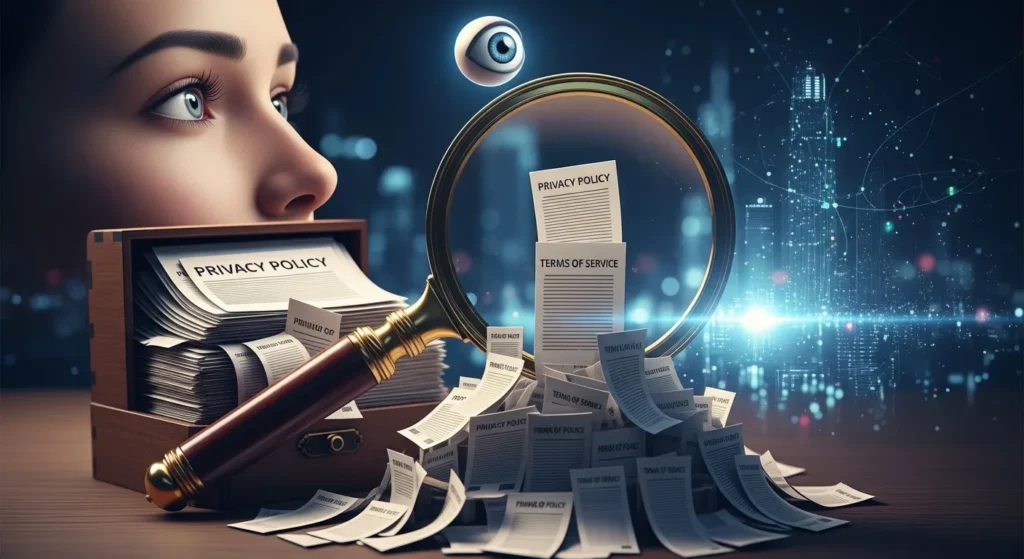
The Document Everyone Agrees to — and No One Reads
You’ve seen it hundreds of times.
A pop-up blocks the screen.
A wall of text appears.
Two buttons wait at the bottom: Accept or Leave.
You don’t scroll.
You don’t skim.
You click and move on.
That moment feels insignificant.
But it’s not.
Because privacy policies quietly decide how your data is collected, combined, stored, shared, and reused — often for years — while remaining effectively unread by the very people they govern.
That isn’t an accident.
It’s design.
The Uncomfortable Truth About Privacy Policies
Privacy policies are often described as informational documents.
In practice, they function as liability shields.
Their primary goals are to:
- Meet legal disclosure requirements
- Transfer responsibility to the user
- Preserve maximum operational flexibility
Helping users understand data practices is rarely the core objective.
If it were, privacy policies would look very different.
Why Privacy Policies Are So Long (On Purpose)
Length discourages reading.
That’s not speculation — it’s documented behavioral science.
Most privacy policies are:
- 5,000–15,000 words long
- Written at a graduate reading level
- Packed with cross-references
- Frequently updated
Reading one carefully can take 30–45 minutes.
Multiply that by dozens of apps and services, and the math becomes impossible.
The result?
Rational neglect.
Complexity as a Defensive Strategy
Privacy policies aren’t just long — they’re complex.
Key tactics include:
- Broad definitions (“including but not limited to…”)
- Layered permissions
- Conditional language (“may,” “could,” “from time to time”)
- Catch-all clauses for future use
This ambiguity serves a purpose.
It allows companies to adapt practices later without rewriting consent.
Flexibility for them.
Opacity for you.
The Legal Incentive to Be Unreadable
From a legal perspective, a privacy policy must:
- Disclose data practices
- Avoid making promises that limit operations
- Protect against lawsuits
Clarity can be risky.
Plain language narrows interpretation.
Specificity creates obligation.
So policies drift toward generality — not because users prefer it, but because lawyers do.
The Illusion of Choice in Privacy Policies
Most users believe privacy policies offer choice.
In reality, the choice is often binary:
- Accept everything
- Don’t use the service
There is rarely:
- Granular consent
- Negotiation
- Meaningful alternatives
Consent exists on paper.
Freedom does not.
This transforms privacy from a right into a hurdle.
The Role of “Notice and Consent”
Modern data systems rely on a principle called notice and consent.
The idea is simple:
If users are informed and they agree, data use is legitimate.
Privacy policies fulfill the “notice” requirement — technically.
Whether users understand the notice is treated as irrelevant.
Once consent is given, responsibility shifts.
Why Platforms Know You Won’t Read Them
Companies have decades of data showing:
- Users rarely read policies
- Short summaries are skipped too
- Behavior doesn’t change after disclosure
Platforms like Google and Meta test interfaces relentlessly.
They know exactly how people behave.
Policies are written with that behavior in mind.
Dark Patterns and Passive Acceptance
Privacy policies are often paired with interface design that nudges acceptance:
- Large “Accept” buttons
- Muted “Settings” links
- Multiple clicks to opt out
- Time pressure (“continue to site”)
These patterns don’t force consent.
They engineer it.
Ignoring the policy becomes the path of least resistance.
What Privacy Policies Commonly Hide in Plain Sight
Important details are rarely emphasized.
They’re buried.
Commonly overlooked clauses include permission to:
- Combine data across services
- Share data with undefined “partners”
- Retain data after account deletion
- Use anonymized or aggregated data indefinitely
- Change policies without explicit re-consent
Nothing here is secret.
It’s just not surfaced.
Privacy Policies vs How People Actually Read
| How Policies Are Written | How Users Behave |
|---|---|
| Long and legalistic | Skim or skip |
| Dense paragraphs | Mobile scrolling |
| Abstract language | Concrete expectations |
| One-time display | Habitual clicking |
| Passive disclosure | Active avoidance |
This mismatch isn’t a failure.
It’s the operating model.
Why This Matters Today (And Long-Term)
Privacy policies don’t just describe current practices.
They authorize future ones.
As companies expand into:
- AI training
- Predictive analytics
- Cross-platform data linking
- Behavioral modeling
Old consent is reused to justify new uses.
Your past clicks shape tomorrow’s systems.
The Emotional Cost of Designed Ignorance
Most people don’t want perfect privacy.
They want reasonable expectations.
When reality diverges from those expectations, trust erodes.
People feel:
- Misled
- Powerless
- Fatigued
- Disengaged
This isn’t because they didn’t read the policy.
It’s because the system was never built for understanding.
Common Myths About Privacy Policies
Myth 1: “They exist to protect users”
Their primary function is corporate protection.
Myth 2: “If it’s disclosed, it’s fair”
Disclosure doesn’t equal comprehension.
Myth 3: “Regulation fixed this”
Regulation increased disclosure — not clarity.
Myth 4: “Reading them solves the problem”
Even informed users often lack real choice.
Real-Life Example: Policy Updates No One Notices
Many platforms update privacy policies regularly.
Notifications often say:
“We’ve updated our policy. Continued use means acceptance.”
Most users never read what changed.
Yet new data practices become authorized instantly.
Consent becomes retroactive.
Mistakes People Commonly Make
- Believing unread policies are harmless
- Assuming “nothing to hide” equals nothing to lose
- Treating privacy as an individual choice
- Ignoring how data is reused later
- Confusing transparency with control
Designed ignorance thrives on these assumptions.
What Would a User-Centered Privacy Policy Look Like?
If understanding were the goal, policies would:
- Use plain language summaries
- Highlight meaningful risks
- Separate optional from required data use
- Require explicit consent for major changes
- Offer real opt-outs
The fact that most don’t is revealing.
Actionable Steps to Reduce Blind Acceptance
You don’t need to read everything — but you can read strategically.
1. Look for Data Sharing Sections
Search for “share,” “partners,” and “third parties.”
2. Pay Attention to Retention Language
“May retain” often means “will retain.”
3. Review Privacy Dashboards
Settings often reveal more than policies.
4. Notice When Policies Change
Updates signal shifts in data strategy.
Hidden Insight: Privacy Policies Normalize Power
Privacy policies don’t just describe rules.
They normalize them.
When everyone accepts broad data use, it becomes the baseline.
Silence becomes agreement.
And over time, expectations shrink.
Key Takeaways
- Privacy policies are designed to meet legal needs, not user understanding
- Length and complexity discourage reading
- Consent is often procedural, not informed
- Important permissions are buried, not highlighted
- Policies authorize future data uses
- Awareness restores some agency
Frequently Asked Questions
1. Are privacy policies legally binding?
Yes. Accepting them often creates enforceable agreements.
2. Why don’t companies simplify them?
Simplicity limits flexibility and increases legal risk.
3. Do privacy laws require clarity?
They require disclosure, not comprehension.
4. Is it pointless to read privacy policies?
Not pointless — but selective reading is more realistic.
5. What’s the most important section to check?
Data sharing, retention, and policy update clauses.
Conclusion: Ignored by Design, Powerful by Default
Privacy policies aren’t broken documents.
They’re successful ones — just not for users.
They achieve exactly what they’re meant to do:
secure consent, preserve flexibility, and minimize friction.
Understanding why privacy policies are designed to be ignored doesn’t require paranoia.
It requires perspective.
Because in the digital world, the most powerful agreements aren’t the ones you negotiate —
They’re the ones you never read.
Disclaimer: This article is for general informational purposes and reflects common digital and legal practices, not specific legal advice.

Natalia Lewandowska is a cybersecurity specialist who analyzes real-world cyber attacks, data breaches, and digital security failures. She explains complex threats in clear, practical language so everyday users can understand what really happened—and why it matters.
Pingback: The Silent Agreements You Accept Without Reading — And How They Quietly Shape Your Digital Life