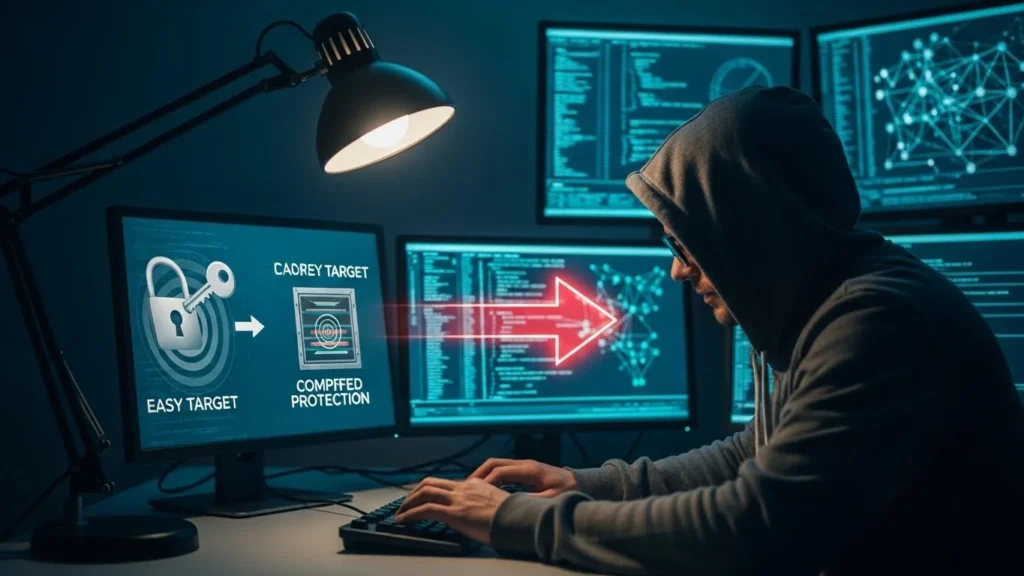
It Usually Happens on a Normal Day
You’re not doing anything risky.
Just checking messages. Scrolling. Working.
Your device feels familiar. Safe.
Nothing unusual catches your attention.
And that’s exactly the point.
Most cyber problems don’t begin with bold mistakes or reckless behavior.
They begin during ordinary moments—when everything feels routine.
This is why hackers don’t chase the “smartest” people online.
They chase the easiest moments.
The Big Misunderstanding About Hackers
Many people believe hackers are after brilliance, secrets, or high-value targets.
In reality, most attackers are not looking for intelligence.
They’re looking for effort reduction.
Hacking isn’t a contest of skill versus skill.
It’s a calculation of time, energy, and probability.
If one path takes ten minutes and another takes ten hours, the choice is obvious.
Why “Easy” Beats “Smart” Every Time
Hackers think in scale.
They don’t need to defeat strong defenses if they can simply walk around them.
They don’t need to outsmart people if they can outpace attention.
An “easy target” is someone who:
- Is busy or distracted
- Trusts routine digital behavior
- Assumes nothing bad will happen
- Relies on habit more than awareness
None of this has anything to do with intelligence.
It has everything to do with human behavior.
How Attacks Actually Start (In Simple Terms)
Most cyber attacks don’t break systems.
They enter through permission.
A click.
A login.
A reply.
The system does exactly what it’s designed to do.
It follows instructions given by a trusted user.
From the attacker’s perspective, that’s perfect.
The Quiet Role of Convenience
Convenience is one of the strongest forces online.
We want things to be:
- Fast
- Familiar
- Frictionless
- Predictable
Hackers design attacks to blend into those expectations.
Anything that feels inconvenient triggers suspicion.
Anything that feels normal lowers it.
This is why easy targets are often people who are simply trying to save time.
Who Is Most Often Considered an “Easy Target”
This might surprise you.
It’s not beginners alone.
Common easy targets include:
- Busy professionals juggling tasks
- Remote workers switching tools all day
- Small business owners wearing many hats
- Students managing multiple platforms
- Experienced users running on autopilot
The more digital life you manage, the more routine actions you perform.
And routines reduce pauses.
What Most People Don’t Realize
Here’s the quiet truth:
Attackers don’t care who you are.
They care how predictable you are.
Predictability is more valuable than personal data.
If behavior is consistent, it can be anticipated.
If it can be anticipated, it can be guided.
That’s the real advantage hackers seek.
The Psychology Behind Easy Targets
This isn’t about fear.
It’s about psychology.
Hackers rely on:
- Familiar branding
- Polite language
- Mild urgency
- Authority cues
- Social norms
Nothing extreme.
Nothing dramatic.
Just enough to keep you moving forward without stopping.
Common Myths That Increase Risk
Let’s gently clear up a few beliefs that quietly increase exposure.
- “I’m careful, so I’m safe.”
Careful people still have distracted moments. - “I would notice something suspicious.”
Modern attacks are designed not to stand out. - “Hackers go after big targets.”
Scale matters more than size. - “I don’t do anything important online.”
Access is valuable, even without obvious assets.
These myths don’t cause attacks.
They reduce hesitation.
Easy Targets vs. Hard Targets: A Simple Comparison
| Easy Targets | Hard Targets |
|---|---|
| Act on autopilot | Pause before acting |
| Trust familiar messages | Verify unexpected ones |
| Click links quickly | Navigate manually |
| Reuse passwords | Use unique credentials |
| Assume safety | Expect verification |
Being a hard target doesn’t require expertise.
It requires small behavioral shifts.
Everyday Behaviors People Overlook
Small habits often matter more than big decisions.
Commonly overlooked behaviors include:
- Clicking links before reading the sender fully
- Responding to messages while multitasking
- Treating branded emails as automatically safe
- Using the same password across services
- Assuming silence means security
These actions feel harmless.
That’s why they’re effective entry points.
What Actually Makes You a Harder Target
Becoming a harder target isn’t about fear or technical skill.
It’s about friction.
Helpful habits include:
- Pausing for a second before clicking
- Checking senders, not just subject lines
- Typing website addresses manually when unsure
- Using a password manager
- Updating devices regularly
These steps don’t stop all threats.
They reduce appeal.
And attackers move on when things slow down.
What Doesn’t Help as Much as People Think
Some actions provide comfort but limited protection:
- Relying only on antivirus software
- Trusting spam filters completely
- Assuming experience equals immunity
- Believing “nothing happened” means “nothing happened”
Technology supports safety.
Behavior defines it.
Why This Matters in Everyday Life
Cybersecurity isn’t about dramatic breaches.
It’s about everyday continuity.
It affects:
- Personal finances
- Work access
- Private conversations
- Photos and memories
- Digital identity
Most problems don’t announce themselves.
They quietly disrupt normal life.
Understanding how hackers choose targets gives you back control—without fear.
Key Takeaways
- Hackers prefer low-effort opportunities, not “smart” victims
- Predictable habits matter more than intelligence
- Most attacks rely on normal behavior
- Small pauses create meaningful protection
- Awareness beats fear every time
Frequently Asked Questions
Are hackers only targeting careless people?
No. They target moments, not personalities. Everyone has distracted moments.
Does being tech-savvy make you safe?
It helps, but habits matter more than knowledge.
Why don’t attackers go after harder targets?
Because effort and time reduce success at scale.
Is avoiding links enough?
No. Awareness, verification, and good habits work together.
Can simple changes really make a difference?
Yes. Attackers move on quickly when things slow down.
A Calm Way to Think About Online Safety
You don’t need to outsmart hackers.
You just need to be less convenient.
Small pauses.
Simple checks.
A little friction.
That’s often enough to make you a hard target.
And that confidence comes from understanding—not fear.
Disclaimer: This article is intended for general awareness and understanding, not professional or specialized advice.

Natalia Lewandowska is a cybersecurity specialist who analyzes real-world cyber attacks, data breaches, and digital security failures. She explains complex threats in clear, practical language so everyday users can understand what really happened—and why it matters.
Pingback: Why Hackers Target Emotions Instead of Technology
Pingback: How Normal Online Behaviour Is Quietly Exploited
Pingback: How Trust Becomes a Security Risk — The Quiet Mistake Even Careful People Make Online
Pingback: Why AI Lowers the Barrier for Cybercrime — How Powerful Tools Turn Amateurs Into Threats
Pingback: Why Small Businesses Lose More After Breaches (And Why Recovery Is So Much Harder)
Pingback: The Most Common Security Mistakes Small Businesses Make — And How to Avoid Them Before It’s Too Late
Pingback: Why SMBs Underinvest in Cybersecurity — The Silent Business Risk Hiding in Plain Sight