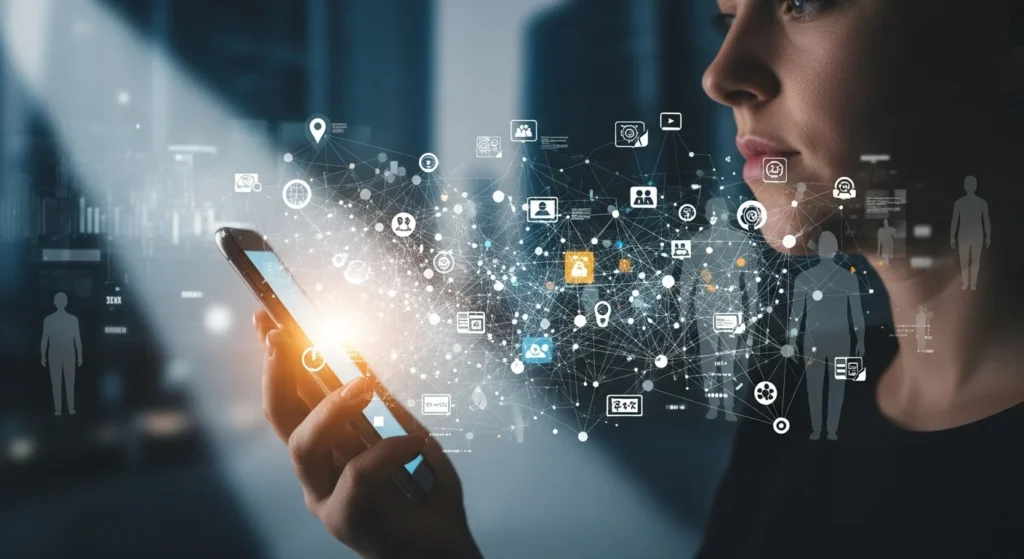
You Never Signed Up — But the System Still Knows You
You never created an account.
You never posted a photo.
You never liked a post.
You never followed anyone.
And yet…
Your name appears in contact lists.
Your photo shows up in tagged images.
Your email is recognized by platforms you never joined.
It feels unsettling.
Because it is.
Social platforms don’t just understand users.
They quietly map everyone around them — including people who never agreed to participate.
This is the hidden side of digital ecosystems:
non-users are still data subjects.
What “Non-User Data” Really Means
A non-user is someone who:
- Has no account on a platform
- Has never logged in
- Has never interacted directly with the platform
Yet their data can still exist inside platform systems.
How?
Because social platforms operate on networks — not individuals.
If users share information about you, you become part of the system.
Even without consent.
Why Social Platforms Care About Non-Users
At first glance, non-users seem irrelevant.
They don’t generate ad revenue directly.
They don’t create content.
They don’t engage.
So why track them?
Because non-users help platforms:
- Understand social networks
- Predict future users
- Improve recommendation algorithms
- Map relationships
- Expand data models
In simple terms:
Non-users complete the puzzle of social graphs.
The Main Ways Platforms Collect Data From Non-Users
1. Contact Uploads From Users
When users sync their contacts, platforms gain access to:
- Names
- Phone numbers
- Email addresses
- Relationship hints
Even if you never joined.
Your data enters the system through someone else’s phone.
This is one of the largest sources of non-user data.
2. Tagged Photos and Videos
When users upload photos and tag people:
- Your face may be analyzed
- Your presence is recorded
- Your connections are inferred
Even without an account.
Platforms can detect faces before tagging happens.
That’s how they build recognition patterns.
3. Website Tracking Pixels
Many websites embed social media tracking tools.
When you visit those sites, platforms may collect:
- IP address
- Device information
- Browser details
- Page behavior
Even if you never use social media.
This data links you to broader digital behavior.
4. Shared Links and Messages
When users share links containing your email or name, platforms may capture:
- Communication patterns
- Social proximity
- Interaction frequency
You become part of someone else’s digital footprint.
5. Public Information Aggregation
Platforms can collect publicly available data from:
- Public websites
- Forums
- News mentions
- Business directories
Combined with other signals, this builds shadow profiles.
What Kind of Data Do Platforms Build About Non-Users?
Non-user data is not random.
It often includes:
- Identity signals (name, email, phone)
- Social connections
- Geographic patterns
- Behavioral inferences
- Demographic predictions
Over time, platforms can infer:
- Who you know
- Where you might live
- What you might like
- Whether you might join
This is not speculation.
It’s how predictive models work.
The Concept of “Shadow Profiles”
A shadow profile is a data profile created about someone without an account.
These profiles are not always visible or accessible.
They exist internally.
Shadow profiles may include:
- Partial identity data
- Network relationships
- Probability scores
They are incomplete — but surprisingly powerful.
Platforms like Meta and Google have faced scrutiny over such practices.
Not because the data is fictional.
But because it’s real.
Real-Life Example: The Contact List Effect
Imagine this scenario:
- Five of your friends upload their contact lists
- Your phone number appears in all five lists
- The platform sees repeated patterns
Result?
You become a highly probable “future user.”
Even without joining.
The system learns your existence through others.
Why This Matters Today (And Beyond)
Digital identity is no longer voluntary.
You don’t need an account to exist in data systems.
Non-user data affects:
- Privacy rights
- Digital reputation
- Identity modeling
- Advertising targeting
- Security risks
The line between user and non-user is dissolving.
And most people don’t realize it.
Non-User Data vs User Data
| User Data | Non-User Data |
|---|---|
| Provided directly | Collected indirectly |
| Visible to the user | Often invisible |
| Consent-based (partly) | Often implicit |
| Editable | Hard to control |
| Transparent features | Hidden systems |
This difference is why non-user data raises ethical questions.
The Hidden Logic Behind Non-User Tracking
From a platform perspective, non-user data solves three problems:
- Network completeness – understanding social connections
- Prediction accuracy – improving recommendation models
- Growth forecasting – identifying potential users
But from a human perspective, it creates a paradox:
You can be tracked without participating.
Common Misconceptions About Non-User Data
1. “If I don’t sign up, I’m invisible”
Not true.
Your network makes you visible.
2. “Platforms can’t store my data legally”
Regulations vary, but indirect data collection often exists in gray zones.
3. “Deleting my data is easy”
Harder than expected — because you never had an account to begin with.
4. “Only big platforms do this”
Many digital services use similar network-based data models.
Psychological Impact: The Feeling of Being Observed Without Participation
Non-user tracking changes how people feel about digital spaces.
It creates:
- Loss of control
- Identity anxiety
- Trust erosion
- Digital fatigue
People realize privacy isn’t just about personal choices.
It’s about collective behavior.
Your privacy depends on others.
Mistakes People Make About Non-User Data
- Assuming privacy is individual
- Ignoring contact-sharing permissions
- Underestimating photo tagging impact
- Believing opt-outs solve everything
Non-user data spreads socially, not individually.
Actionable Steps to Reduce Non-User Data Exposure
You can’t eliminate it completely.
But you can reduce it.
1. Ask Contacts to Limit Contact Syncing
Many people don’t realize their apps upload entire address books.
2. Avoid Public Tagging
Request friends to avoid tagging non-users in public posts.
3. Use Privacy-Focused Browsing
Tracking pixels are less effective with stricter browser settings.
4. Monitor Your Digital Presence
Search your name periodically to understand your data footprint.
Hidden Insight: Non-Users Are More Valuable Than They Seem
Ironically, non-users can be more valuable than users.
Why?
Because they represent:
- Untapped growth
- Unknown behaviors
- Future markets
Platforms don’t just monetize attention.
They monetize potential attention.
Non-users embody that potential.
Ethical and Regulatory Questions
Non-user data raises difficult questions:
- Who owns indirect data?
- Can consent be inherited through others?
- Should non-users have access rights?
- How transparent should platforms be?
These questions remain unresolved globally.
Technology evolved faster than regulation.
Key Takeaways
- Social platforms collect data about non-users indirectly
- Contact lists, photos, and tracking pixels are major sources
- Shadow profiles can exist without accounts
- Non-user data shapes algorithms and growth strategies
- Privacy is now collective, not individual
- Awareness is the first step to control
Frequently Asked Questions
1. Can social platforms really track people without accounts?
Yes. Indirect data collection through users, websites, and public sources makes it possible.
2. Is non-user data stored permanently?
Retention policies vary, but some data can persist for long periods.
3. Can non-users request data deletion?
In some regions, laws allow requests, but enforcement is complex.
4. Does using private browsers stop non-user tracking?
It reduces tracking but doesn’t eliminate data shared by other users.
5. Why don’t platforms openly talk about non-user data?
Because it’s technically complex, ethically sensitive, and difficult to explain without controversy.
Conclusion: You Don’t Have to Join to Be Counted
Social media no longer ends at account boundaries.
It extends through relationships, devices, and digital traces.
You may never post a photo.
Never like a video.
Never follow a profile.
Yet your existence still shapes the system.
That’s the quiet truth of modern data ecosystems:
In the age of networks, participation is optional — but visibility is not.
Understanding this reality doesn’t mean rejecting technology.
It means using it with clearer awareness.
Because in the digital world, the most powerful data isn’t always what you share.
It’s what others share about you.
Disclaimer: This article is for general informational purposes and reflects common digital practices, not specific platform policies or legal advice.

Natalia Lewandowska is a cybersecurity specialist who analyzes real-world cyber attacks, data breaches, and digital security failures. She explains complex threats in clear, practical language so everyday users can understand what really happened—and why it matters.