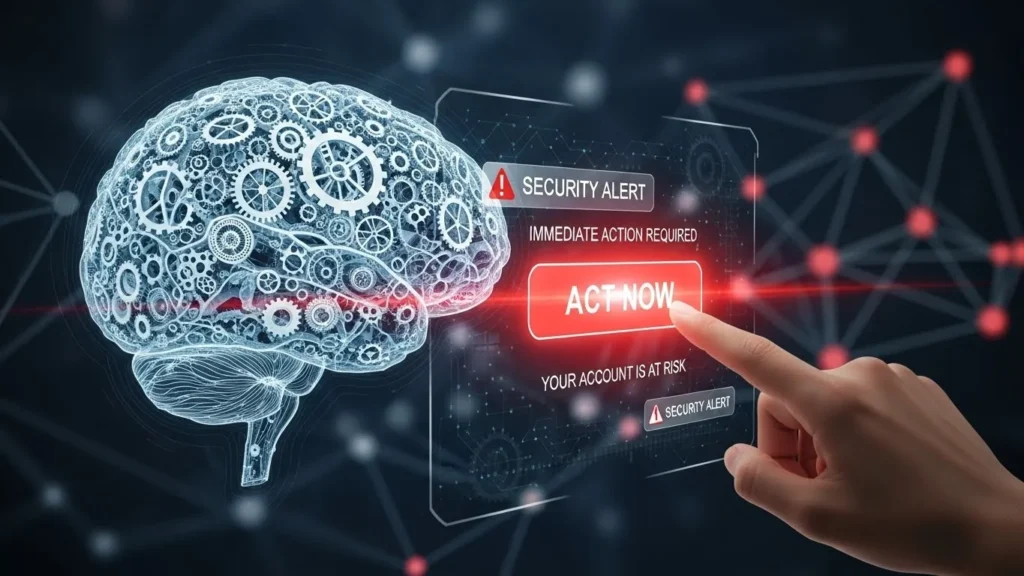
That Split Second Where Logic Disappears
You’re checking email between tasks.
A message jumps out:
“Unusual activity detected. Immediate action required.”
Your heart rate changes.
Your focus narrows.
You click.
Only later—sometimes much later—does the question appear:
Why did that feel so urgent?
The answer has very little to do with technology.
Urgent security messages work because they exploit deep, predictable psychological responses that evolved long before email, passwords, or the internet ever existed.
And once you understand that trick, these messages lose much of their power.
Urgency Is Not a Feature — It’s a Weapon
Real security systems aim to protect you.
Fake ones aim to rush you.
Urgency is the most reliable way to:
- Short-circuit analysis
- Override skepticism
- Force immediate action
When time feels scarce, the brain prioritizes speed over accuracy.
That’s not a flaw.
That’s survival wiring.
Attackers simply learned how to pull that lever digitally.
What Happens in Your Brain When Urgency Appears
Urgent messages trigger the brain’s threat-response system.
In that state:
- Attention narrows
- Critical thinking slows
- Pattern recognition dominates
- Mistakes increase
This is the same response that helped humans survive physical danger.
But online, the threat is often imagined or manufactured.
Urgency creates a false emergency—one that feels real enough to act on.
Why “Immediate Action Required” Is So Effective
That phrase isn’t accidental.
It combines three powerful psychological cues:
- Loss aversion – Fear of losing access, money, or control
- Authority – Appearing to come from a trusted system
- Time pressure – Removing the option to think
Together, they create a narrow mental tunnel:
Fix the problem now, or suffer consequences.
Once inside that tunnel, verification feels like delay—and delay feels dangerous.
Real-Life Urgent Messages You’ve Probably Seen
These formats appear everywhere because they work:
- “Your account will be locked in 24 hours”
- “Suspicious login detected — verify now”
- “Payment failed — update details immediately”
- “Security breach detected — reset password”
- “Unusual activity — confirm identity”
Attackers frequently mimic platforms like Google, Microsoft, or Apple because trust lowers resistance.
The message doesn’t need to be perfect.
It just needs to feel plausible and urgent.
The Hidden Psychological Shortcut Being Exploited
Urgent messages rely on a shortcut called heuristic decision-making.
When time feels limited, the brain asks:
- Does this look familiar?
- Does it feel official?
- Does it match something that could happen?
If the answer is “yes,” action follows.
Attackers design messages to score high on these shortcuts—logos, tone, timing—so your brain decides before your logic catches up.
Why Even Cyber-Aware People Still Fall for It
Knowledge doesn’t erase biology.
Even security professionals have clicked urgent messages during:
- Heavy workloads
- Fatigue
- Stress
- Distraction
Urgency works best when:
- You’re multitasking
- You’re emotionally engaged
- You’re trying to be responsible
Ironically, people who care about security often react faster, because they don’t want to ignore a potential threat.
The Familiarity + Urgency Combination
Urgency alone isn’t enough.
It must be wrapped in familiarity.
That’s why urgent messages often:
- Reference real services you use
- Match your usual communication style
- Arrive at realistic times
- Avoid extreme language
When urgency feels normal, resistance drops even further.
Legitimate Alerts vs Manipulative Urgency
| Feature | Legitimate Security Alert | Manipulative Urgent Message |
|---|---|---|
| Tone | Informative | Pressuring |
| Timing | Flexible | Immediate |
| Action | Options provided | Single urgent action |
| Language | Calm, clear | Fear-based |
| Verification | Encouraged | Discouraged |
Real security alerts allow time.
Fake ones remove it.
Why This Matters More Than Ever
Digital life now controls:
- Finances
- Identity
- Work access
- Communication
Urgent security messages are effective because they target systems we can’t afford to lose.
Attackers don’t need to break encryption if they can rush the human behind the screen.
And the more integrated digital systems become, the more powerful urgency grows.
Common Mistakes People Make Under Urgency
These errors happen fast—and feel justified in the moment:
- Clicking links instead of opening sites manually
- Entering credentials to “stop” a problem
- Ignoring small inconsistencies
- Acting before verifying sender details
- Believing speed equals responsibility
Urgency reframes caution as risk.
That’s the trick.
The One Mental Shift That Breaks Urgency
Instead of asking:
“What if this is real?”
Ask:
“Why am I being rushed?”
Legitimate systems prioritize accuracy over speed.
Attackers prioritize speed over everything.
That question alone slows the process enough for logic to re-enter.
Practical Habits That Defuse Urgent Messages
You don’t need complex tools—just consistent pauses.
Actionable steps:
- Never act directly from urgent messages
- Open accounts manually via bookmarks
- Treat countdowns as red flags
- Verify alerts through a second channel
- Assume urgency is a manipulation attempt until proven otherwise
Ten seconds of pause defeats most attacks.
Why Urgency Will Always Be Used
As long as humans:
- Feel fear of loss
- Respect authority
- React to pressure
Urgency will remain effective.
Technology will evolve.
Filters will improve.
But psychology remains stable.
The goal isn’t eliminating urgent messages—it’s recognizing when urgency is being used against you.
Key Takeaways
- Urgent security messages exploit survival psychology
- Time pressure reduces critical thinking
- Familiar branding lowers resistance
- Smart people fall for urgency under stress
- Pausing breaks the psychological spell
Frequently Asked Questions
1. Are urgent security messages always fake?
No. Some are legitimate—but real alerts allow time and verification without pressure.
2. Why does urgency feel so convincing?
Because it triggers the brain’s threat response, prioritizing action over analysis.
3. Is ignoring urgent messages dangerous?
Ignoring blindly can be risky. The key is verifying through trusted channels instead of reacting instantly.
4. What’s the biggest red flag in urgent alerts?
Pressure to act immediately without offering safe verification options.
5. Can training eliminate urgency mistakes?
Training helps, but habits and pauses are more reliable than knowledge alone.
Conclusion: Urgency Isn’t Information — It’s Influence
Urgent security messages don’t win by being accurate.
They win by making you feel like thinking is a luxury you don’t have.
Once you recognize urgency as a psychological tactic—not proof of danger—you regain control.
The safest response to “Act now” is almost always the same:
Pause first.
Disclaimer: This article is for general informational purposes only and does not substitute personalized cybersecurity or technical advice.

Natalia Lewandowska is a cybersecurity specialist who analyzes real-world cyber attacks, data breaches, and digital security failures. She explains complex threats in clear, practical language so everyday users can understand what really happened—and why it matters.