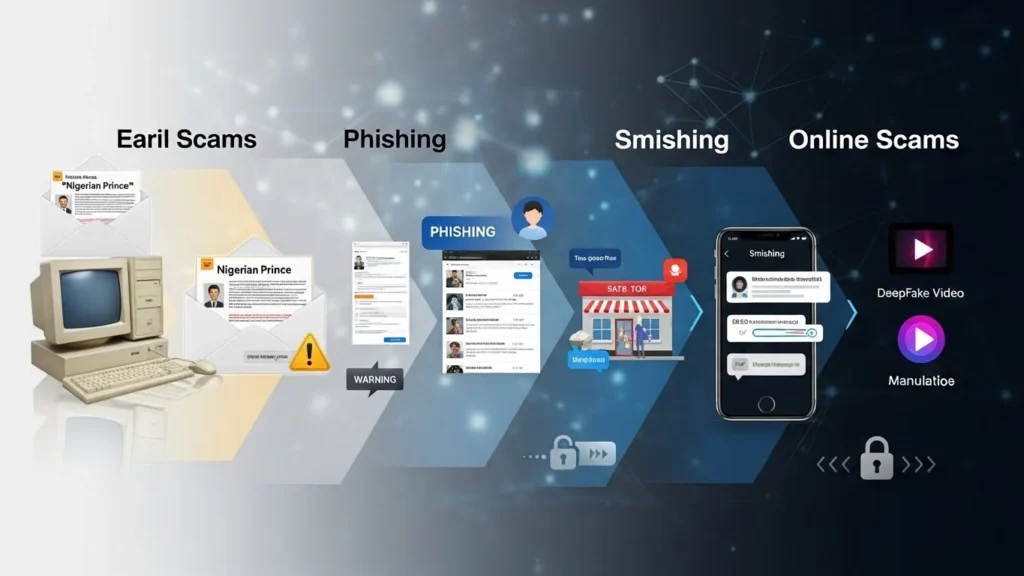
You Learned to Spot Scams — Then They Changed
There was a time when online scams were easy to recognize.
Bad grammar.
Strange promises.
Emails from “princes” and fake lotteries.
Most people learned to ignore them.
So scammers adapted.
What followed wasn’t a sudden leap—but a quiet evolution that happened while people felt safer online, not more cautious.
Today’s scams don’t announce themselves.
They blend in.
And that’s why so many people don’t realize how much they’ve changed.
The Early Era: When Scams Were Loud and Obvious
Early online scams relied on attention-grabbing absurdity.
They worked by:
- Promising unrealistic rewards
- Using shock value
- Targeting unfamiliar internet users
The goal was simple: reach as many people as possible and hope a few responded.
These scams were:
- Easy to spot
- Poorly written
- Emotionally extreme
As digital literacy improved, their success rate dropped.
Scammers noticed.
The First Shift: From Greed to Believability
The next phase focused less on “winning big” and more on sounding reasonable.
Scammers began:
- Mimicking real companies
- Using professional language
- Offering “small problems” instead of big rewards
Instead of “You won money,” the message became:
“There’s an issue with your account.”
That felt plausible.
This shift marked the beginning of trust-based scams—and most people didn’t notice it happening.
The Familiarity Revolution
Modern scams rely on recognition, not surprise.
Attackers copy:
- Email layouts
- Brand colors
- Notification styles
- Customer service tone
Messages pretending to come from platforms like Amazon, Google, or Microsoft work because people already trust them.
Trust removes friction.
Friction is what stops scams.
When Scams Stopped Interrupting and Started Blending In
One of the biggest changes went unnoticed:
Scams stopped interrupting daily life.
They started integrating into it.
Today’s scams appear as:
- Delivery updates
- Shared documents
- Security alerts
- Payment issues
- Work-related messages
They don’t demand your full attention.
They ask for one small action.
That’s far more effective.
The Rise of Social Engineering
As technology improved, scammers realized something important:
The weakest point wasn’t software.
It was human behavior.
This led to widespread use of social engineering—attacks that exploit:
- Trust
- Urgency
- Authority
- Responsibility
Instead of hacking systems, scammers learned to ask people to open the door themselves.
This wasn’t louder.
It was quieter.
And much harder to detect.
Why Scam Evolution Feels Invisible
Most people think scams change suddenly.
In reality, they evolve gradually.
Each version:
- Looks slightly more normal
- Feels slightly more reasonable
- Requires slightly less suspicion
Over time, people adjust their expectations—without realizing it.
The danger isn’t missing a scam.
It’s lowering your guard without noticing.
Old Scams vs Modern Scams
| Feature | Old Online Scams | Modern Online Scams |
|---|---|---|
| Appearance | Obvious | Familiar |
| Language | Poor | Polished |
| Emotion | Greed or fear | Responsibility & urgency |
| Target | Random users | Context-aware users |
| Detection | Easier | Subtle |
Scams didn’t disappear.
They grew up.
Why Smart, Cautious Users Are Now Targeted
Modern scams don’t aim for the uninformed.
They target:
- Professionals
- Business owners
- Remote workers
- Digitally active users
Why?
Because these users:
- Act quickly
- Manage important systems
- Trust routine messages
- Feel responsible for fixing issues
The better you function online, the more believable scams become.
Real-Life Examples of Evolved Scams
The “Routine” Security Alert
A message warns of unusual activity. Nothing dramatic. Just a suggestion to “verify.”
The Workplace Request
A message appears from a colleague asking for something small and time-sensitive.
The Subscription Issue
A billing problem seems minor—but urgent enough to act on.
Each one mirrors normal digital life.
That’s the evolution.
Why This Matters Today (And Going Forward)
Digital systems now control:
- Identity
- Finances
- Work access
- Personal data
Scams no longer need to steal everything at once.
They just need:
- One click
- One confirmation
- One moment of trust
The evolution of scams makes delayed damage more common—losses often surface long after the original message is forgotten.
Common Mistakes People Make Because Scams Feel Normal
These errors don’t feel like mistakes in the moment:
- Clicking links instead of navigating manually
- Trusting familiar branding
- Acting quickly to “fix” small issues
- Assuming spam filters catch everything
- Believing “this looks normal” equals safe
Modern scams rely on reasonable behavior in the wrong context.
Subtle Signs the Evolution Left Behind
Even advanced scams still leak clues:
- Unexpected messages tied to routine actions
- Pressure to act quickly
- Single-action solutions
- No time to verify independently
- Slight inconsistencies in tone or timing
The problem isn’t spotting scams.
It’s remembering to look.
Simple Habits That Outpace Scam Evolution
You don’t need to track every new scam type.
You need habits that don’t depend on scam design.
Actionable steps:
- Pause before acting on unexpected routine messages
- Access accounts manually instead of clicking links
- Verify requests through a second channel
- Treat urgency as a signal, not a command
- Ask: Was I expecting this?
These habits stay effective—even as scams evolve.
Why Scams Will Keep Evolving
Scams evolve because:
- Platforms change
- User habits stabilize
- Trust remains essential
As long as online life depends on trust, scammers will try to borrow it.
The goal isn’t to stay ahead of every scam.
It’s to stay grounded in behavior that resists manipulation.
Key Takeaways
- Online scams evolved quietly, not dramatically
- Familiarity replaced obvious deception
- Modern scams blend into daily routines
- Smart, active users are common targets
- Simple behavioral habits defeat most evolved scams
Frequently Asked Questions
1. Why don’t scams look suspicious anymore?
Because obvious scams stopped working. Modern scams succeed by blending into normal online behavior.
2. Are online scams more common now?
They’re more visible because they’re more effective—and harder to detect.
3. Do spam filters stop modern scams?
They help, but many scams rely on human trust rather than technical loopholes.
4. What’s the biggest mistake people make today?
Acting quickly on routine-looking messages without verifying the source.
5. Can scam evolution ever stop?
Unlikely. But awareness and strong habits significantly reduce risk.
Conclusion: The Most Dangerous Changes Are the Quiet Ones
Online scams didn’t get louder.
They got calmer.
More polite.
More familiar.
That evolution happened quietly—while people felt safer, not more alert.
Staying safe today doesn’t mean spotting obvious danger.
It means pausing when something ordinary asks you to act immediately.
That pause is often the only signal you’ll get.
Disclaimer: This article is for general informational purposes only and does not replace professional advice for specific online security or fraud situations.

Natalia Lewandowska is a cybersecurity specialist who analyzes real-world cyber attacks, data breaches, and digital security failures. She explains complex threats in clear, practical language so everyday users can understand what really happened—and why it matters.