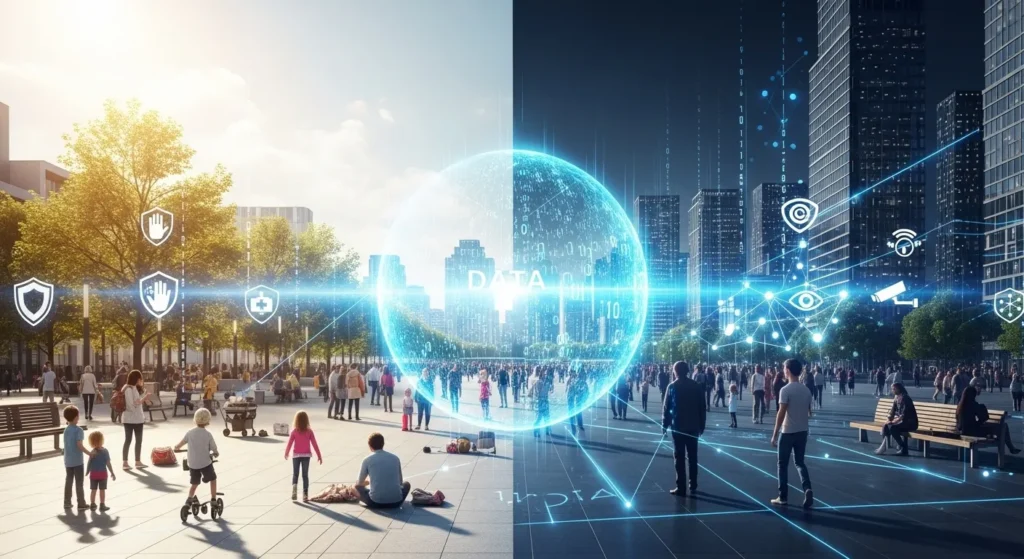
Imagine calling emergency services.
Before help even arrives, systems may already know:
- Your location
- Nearby incidents
- Traffic conditions
- Crime patterns in the area
- The fastest response route
That is the new reality.
Public safety today is no longer built only on police officers, firefighters, or ambulances.
It is increasingly built on data.
Data collection now shapes how cities prevent crime, respond to emergencies, manage crowds, and even predict risks before events unfold.
But this shift also comes with deeper questions:
Are we becoming safer…
or simply more monitored?
Let’s explore how data collection is quietly transforming public safety—and what it means for everyday life.
Public Safety Has Entered the Age of Information
In the past, safety relied on:
- Patrols
- Human observation
- Community reports
- Reactive emergency response
Today, safety systems are powered by constant streams of information.
Modern cities collect data through:
- Security cameras
- Smartphones and location signals
- Social media monitoring
- Traffic sensors
- Smart streetlights
- License plate readers
- Emergency call analytics
Public safety is becoming a data-driven ecosystem.
The streets aren’t just watched.
They are measured.
What Does “Data Collection” Mean in Public Safety?
Data collection in public safety refers to gathering information that helps authorities and systems:
- Identify threats
- Predict risks
- Respond faster
- Allocate resources
- Monitor public spaces
This includes both digital and physical data.
Common types of public safety data
- Video surveillance footage
- GPS and mobility data
- Crime statistics
- Facial recognition templates
- Gunshot detection sensors
- Online behavioral patterns
The goal is simple:
Use information to reduce harm.
But the scale is unprecedented.
Why Data Collection Is Expanding So Rapidly
Public safety organizations are collecting more data because modern risks are complex.
Cities face:
- Cybercrime
- Terror threats
- массов crowd events
- Faster urban growth
- Resource shortages
Data allows governments to act smarter, not just harder.
Key reasons for growth
- Technology is cheaper and widespread
- AI can process information instantly
- Public demand for security is rising
- Real-time monitoring reduces response times
Safety has become inseparable from data infrastructure.
Real-Life Examples of Data Shaping Public Safety
This is already happening around you.
Predicting where crime may occur
Some departments use predictive analytics to identify high-risk areas based on historical patterns.
Smart traffic systems
Sensors detect congestion, accidents, and dangerous intersections automatically.
Emergency medical response
Ambulance routing uses live traffic data for faster arrival.
Crowd control at events
Large gatherings are monitored using mobile signals and camera analytics to prevent stampedes or violence.
Disaster management
Weather, mobility, and communication data help coordinate evacuation and rescue.
Public safety is no longer just boots on the ground.
It is algorithms in the background.
The Benefits: How Data Can Make Communities Safer
When used responsibly, data collection can save lives.
Major advantages include:
- Faster emergency response
- Better crime prevention
- Smarter resource allocation
- Improved disaster preparedness
- Early warning systems for violence
Example: Gunshot detection technology
Some cities use acoustic sensors that detect gunfire and notify police instantly—often faster than a 911 call.
That’s data working as protection.
Comparison Table: Traditional Safety vs Data-Driven Safety
| Feature | Traditional Public Safety | Data-Driven Public Safety |
|---|---|---|
| Approach | Reactive | Preventive + predictive |
| Main resource | Human patrols | Data + AI systems |
| Speed | Slower response | Real-time alerts |
| Coverage | Limited visibility | Wide-area monitoring |
| Decision-making | Experience-based | Analytics-driven |
| Risks | Human bias | Algorithmic bias + privacy loss |
The Hidden Trade-Off: Safety vs Privacy
Here is where things become complicated.
Data collection improves safety…
But it also increases surveillance.
The same system that detects threats may also track innocent people.
Questions arise:
- Who controls the data?
- How long is it stored?
- Who has access?
- Can it be misused?
- What counts as suspicious behavior?
Public safety and personal freedom are now deeply linked through information.
The Risk of “Surveillance Creep”
One major danger is expansion beyond the original purpose.
A system installed for traffic safety may later be used for policing.
A camera meant for theft prevention may later enable facial recognition.
This gradual expansion is called surveillance creep:
Small safety tools slowly become broad monitoring systems.
It rarely happens overnight.
AI Is Changing Public Safety Decision-Making
Data alone doesn’t shape safety.
AI shapes how data is interpreted.
Modern systems can:
- Detect fights before they escalate
- Recognize wanted vehicles
- Flag “unusual” movement patterns
- Monitor behavior in crowds
But AI introduces new problems:
- False positives
- Biased training data
- Lack of transparency
- Automated decision-making without accountability
AI may not understand context.
Yet it increasingly influences human response.
Mistakes to Avoid in Data-Driven Safety Systems
Public safety data can help, but misuse is costly.
Common mistakes include:
- Collecting too much unnecessary data
- Using systems without public transparency
- Failing to secure sensitive information
- Over-trusting predictive algorithms
- Deploying facial recognition without oversight
- Ignoring community consent
Safety should never come at the cost of unchecked control.
Hidden Tips for Citizens: How to Stay Informed and Protected
Most people feel powerless in data-driven environments.
But awareness matters.
Practical steps you can take
- Read local policies on surveillance tools
- Support transparency in city technology
- Limit app permissions that share location data
- Advocate for strong privacy laws
- Ask questions when monitoring expands
- Understand your digital footprint
The safest society is not the most watched…
It is the most accountable.
Why This Matters Today (and Beyond)
Public safety is being rebuilt quietly around data.
The future of cities will depend on how this balance is managed:
Data collection can absolutely save lives.
But without ethical limits, it can also reshape society in ways people never agreed to.
The real issue isn’t data itself.
It’s power.
Key Takeaways
- Data collection now shapes public safety across cities and systems
- Surveillance tools help prevent crime, manage traffic, and improve emergency response
- AI allows real-time analysis but introduces bias and errors
- Data-driven safety offers benefits but raises major privacy concerns
- Transparency, regulation, and accountability are essential
- The future depends on balancing protection with freedom
FAQ: How Data Collection Shapes Public Safety
1. How does data improve public safety?
It enables faster response, predictive risk detection, and smarter resource allocation.
2. Is data collection the same as surveillance?
Not always, but it can become surveillance when monitoring expands without clear limits.
3. What technologies collect public safety data?
Cameras, sensors, smartphones, AI analytics, license plate readers, and online monitoring tools.
4. Can AI systems make public safety mistakes?
Yes. False alerts, biased predictions, and misidentification are real risks.
5. How can societies ensure ethical use of safety data?
Through strong privacy laws, oversight, transparency, and limiting unnecessary collection.
Safety Is Now Powered by Information
Public safety is no longer built only on people and patrols.
It is built on data streams, algorithms, sensors, and predictive systems.
This transformation offers hope:
- Faster help
- Smarter prevention
- More efficient protection
But it also demands vigilance.
Because the more safety depends on data…
the more important it becomes to ask:
Who is collecting it, why, and where does the line get drawn?
The future of public safety will not be decided by technology alone…
It will be decided by trust, ethics, and accountability.

Natalia Lewandowska is a cybersecurity specialist who analyzes real-world cyber attacks, data breaches, and digital security failures. She explains complex threats in clear, practical language so everyday users can understand what really happened—and why it matters.