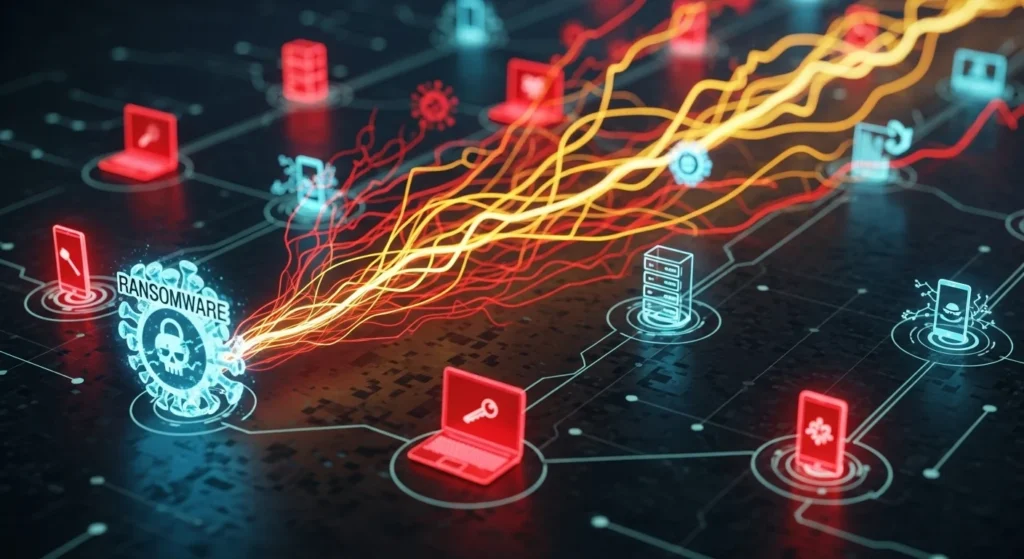
Ransomware Doesn’t Break In — It Flows Through
When people imagine ransomware, they picture a single infected computer.
That image is outdated.
Modern ransomware spreads like a chain reaction, not a single event.
It doesn’t crawl slowly from device to device.
It moves through trust, speed, and automation.
By the time the ransom note appears, the attack has usually already succeeded.
This article explains why ransomware spreads so quickly, how attackers exploit normal systems, and what most people misunderstand about how these attacks really work.
The First Misconception: Ransomware Isn’t One Attack
Ransomware isn’t a single action.
It’s a process.
The visible lock screen or ransom message is often the final step, not the beginning.
Before that moment:
- Systems are scanned
- Credentials are harvested
- Network paths are mapped
- Backup systems are located
The speed comes from preparation, not chaos.
Why One Infected Device Is Rarely the Real Problem
Most ransomware outbreaks don’t start with a dramatic breach.
They start quietly.
Common entry points include:
- A phishing email opened by one employee
- A compromised password reused across systems
- An exposed remote access service
Once inside, ransomware doesn’t rush.
It learns.
This learning phase allows attackers to move faster later—when it matters most.
Credential Theft: The Accelerator Nobody Notices
The fastest way ransomware spreads isn’t through files.
It’s through credentials.
Once attackers steal valid usernames and passwords, they no longer look like intruders.
They:
- Log in normally
- Use legitimate tools
- Move laterally without triggering alarms
From the system’s perspective, everything looks authorized.
That’s why credential theft is often the turning point between a small incident and a full-scale outbreak.
Lateral Movement: How Ransomware Jumps Systems Instantly
Modern networks are designed for convenience.
So is ransomware.
After gaining access, attackers:
- Identify connected devices
- Scan shared folders
- Locate servers and backups
Then they move sideways, not forward.
This lateral movement allows ransomware to spread across:
- File servers
- Cloud systems
- Backup environments
All before encryption even begins.
Automation Makes Ransomware Unstoppably Fast
Speed is no longer human-driven.
Most ransomware attacks use automation.
That means:
- Scripts execute simultaneously
- Multiple systems are targeted at once
- Encryption begins everywhere within minutes
Once the trigger is pulled, stopping the spread becomes nearly impossible.
This is why response time matters more than response strength.
Why Trust Relationships Help Ransomware Spread
Networks are built on trust.
Ransomware exploits that.
Examples include:
- Trusted internal connections
- Shared admin accounts
- Automatic system permissions
Attackers don’t need to break every door.
They just walk through the ones already open.
This is one reason ransomware spreads faster inside organizations than from outside.
Phishing Isn’t About Trickery — It’s About Timing
Modern phishing attacks are subtle.
They often:
- Mimic real workflows
- Use familiar language
- Arrive during busy moments
One distracted click is enough.
From there, ransomware doesn’t immediately explode—it waits, spreads quietly, and then activates when the damage will be maximum.
Why Ransomware Targets Backups First
One reason ransomware spreads so aggressively is backup neutralization.
Attackers actively seek:
- Backup servers
- Cloud snapshots
- Recovery systems
They often encrypt or delete these before launching the main attack.
This ensures:
- Faster compliance
- Higher ransom success
- Fewer recovery options
The speed here is strategic, not accidental.
Comparison Table: Slow Malware vs. Fast Ransomware
| Feature | Traditional Malware | Modern Ransomware |
|---|---|---|
| Spread speed | Gradual | Explosive |
| Primary goal | Persistence | Leverage |
| Movement style | Random | Planned & lateral |
| Credential use | Limited | Central strategy |
| Backup targeting | Rare | Immediate |
| Visibility | Low early | Sudden at end |
Why This Matters Today (Even If You’re Careful)
Ransomware doesn’t require careless behavior.
It exploits:
- Shared systems
- Trust chains
- One weak link
Even security-aware users can be affected indirectly.
The faster ransomware spreads, the less time there is to respond—and the more leverage attackers gain.
Common Mistakes That Help Ransomware Spread Faster
Many defenses fail because of assumptions.
Common mistakes include:
- Believing one device equals one infection
- Reusing passwords across systems
- Leaving internal networks overly permissive
- Delaying software updates
Ransomware thrives on normal operations, not obvious negligence.
Actionable Steps That Slow Ransomware Down
Stopping ransomware entirely is hard.
Slowing it down is achievable.
Effective steps include:
- Segmenting networks
- Limiting credential privileges
- Monitoring unusual login patterns
- Protecting and isolating backups
Every delay reduces impact.
Time is ransomware’s greatest ally—and its biggest weakness.
Key Takeaways
- Ransomware spreads through trust, not chaos
- Credential theft accelerates infection dramatically
- Automation enables near-instant outbreaks
- Lateral movement is the real danger
- Backups are targeted early, not last
- Slowing spread is as important as prevention
Understanding speed is the first defense.
Frequently Asked Questions
Why does ransomware spread faster than other malware?
Because it uses automation, stolen credentials, and trusted system paths.
Can ransomware spread without user interaction?
Yes. Once inside, it often spreads independently.
Is ransomware usually detected early?
No. Detection often happens after encryption begins.
Do backups stop ransomware?
Only if they’re isolated and protected from the same network.
Is ransomware mainly a business problem?
No. Individuals, families, and shared systems are all targets.
Conclusion: Ransomware Wins by Moving First
Ransomware doesn’t rely on brute force.
It relies on speed, silence, and structure.
By the time it reveals itself, it has already spread, secured leverage, and limited recovery options.
Understanding how ransomware moves—not just how it encrypts—is the difference between reacting and resisting.
And in ransomware defense, seconds matter more than tools.
Disclaimer: This article is for general educational purposes only and does not replace professional cybersecurity guidance or security tools.

Natalia Lewandowska is a cybersecurity specialist who analyzes real-world cyber attacks, data breaches, and digital security failures. She explains complex threats in clear, practical language so everyday users can understand what really happened—and why it matters.