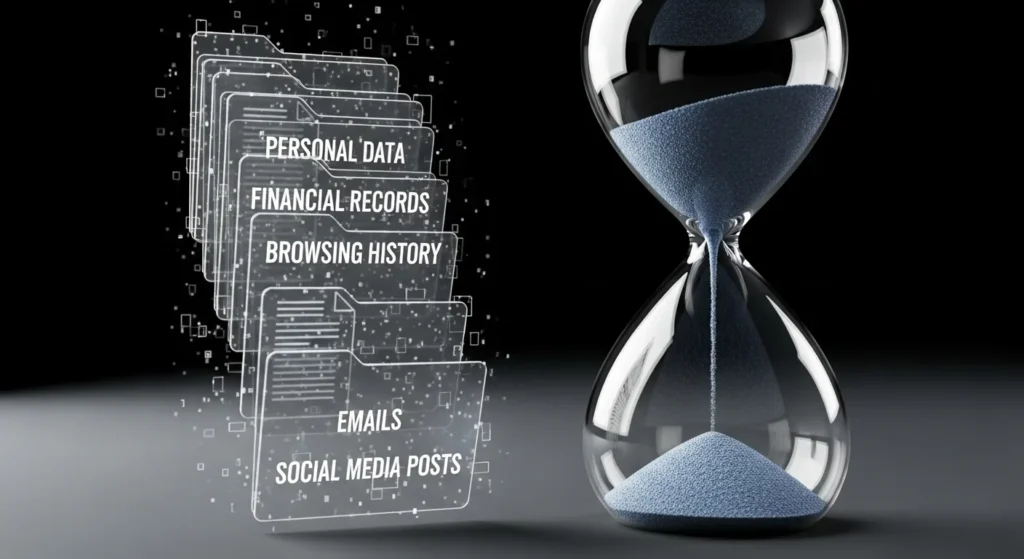
You Assumed It Was Gone
You closed the account.
You uninstalled the app.
You stopped using the service years ago.
It feels finished.
But inside company systems, your information often tells a very different story.
Because in the modern data economy, “keep” doesn’t mean what most people think it means — and “delete” almost never means immediate erasure.
Your data doesn’t just disappear.
It fades, fragments, and lingers.
The First Misunderstanding: Data Has a Lifecycle, Not an Expiry Date
Most people imagine data like food in a fridge.
Use it.
Store it.
Throw it away.
Companies don’t.
They treat data as an asset with a lifecycle, not a shelf life.
That lifecycle includes:
- Active use
- Dormant storage
- Archival retention
- Backup preservation
- Anonymized reuse
Deletion is often only one possible outcome — and not the most common one.
What “Data Retention” Actually Means
When companies talk about retention, they’re referring to how long different categories of data remain accessible or stored, not how long you can see them.
Retention policies are usually split into layers:
- User-facing data
- Operational data
- Security logs
- Financial records
- Analytical datasets
Each layer follows different timelines.
And most users only ever see one.
The Types of Data Companies Keep (And Treat Differently)
Not all data is equal.
Companies typically separate information into categories like:
- Account data (name, email, profile)
- Content data (posts, uploads, messages)
- Behavioral data (clicks, views, interactions)
- System data (logs, timestamps, IPs)
- Derived data (inferences, scores, predictions)
Deleting one category rarely affects the others.
That’s where expectations and reality diverge.
Why Companies Keep Data Longer Than You Expect
This isn’t always about exploitation.
There are structural reasons data persists.
1. Legal and Regulatory Requirements
Companies may be required to retain data for:
- Financial audits
- Tax compliance
- Fraud investigations
- Law enforcement requests
These obligations often last years, not months.
2. Security and Abuse Prevention
To detect fraud, spam, or abuse, platforms keep:
- Access logs
- Device fingerprints
- Behavioral signals
These records help identify patterns — and are rarely deleted quickly.
3. Backups and Disaster Recovery
Large systems maintain:
- Redundant backups
- Snapshot archives
- Geographic replicas
When you delete data from live systems, it may still exist in backups for extended periods.
This isn’t visible — but it’s standard practice.
What Happens When You Delete an Account
Account deletion usually triggers a process, not an event.
Typical steps include:
- Access is disabled
- Profile becomes invisible
- Content may be removed or anonymized
- Some data is queued for deletion
- Other data enters long-term retention
This process can take weeks — or never fully complete.
Especially for non-content data.
The Difference Between Deletion and Anonymization
Many companies prefer anonymization over deletion.
Why?
Because anonymized data:
- Reduces legal risk
- Preserves analytical value
- Keeps historical insight
Once identifiers are removed, data can often be retained indefinitely.
From a system perspective, the identity is gone — but the behavior remains.
Real-World Examples of Long Retention
Large platforms like Google and Meta disclose in their policies that:
- Some data is retained as long as necessary
- Some logs persist for extended periods
- Some data is anonymized rather than deleted
This isn’t hidden — but it’s rarely read carefully.
How Long Is “As Long As Necessary”?
That phrase appears everywhere.
It sounds reasonable.
But it’s intentionally flexible.
“As long as necessary” can mean:
- Until legal obligations end
- Until internal risk decreases
- Until systems are re-architected
- Until data loses analytical value
In practice, that often means years.
Sometimes decades.
Data Retention vs User Expectations
| What Users Expect | What Companies Do |
|---|---|
| Deletion is immediate | Deletion is staged |
| All data disappears | Some data persists |
| One retention period | Many timelines |
| Visibility equals existence | Invisibility ≠ deletion |
| Deletion is final | Data may be repurposed |
This gap fuels most privacy frustration.
Why This Matters Today (And Later)
Data retention shapes:
- Privacy risk exposure
- Breach impact
- Profiling accuracy
- Long-term identity modeling
The longer data exists, the more chances it has to be:
- Accessed
- Combined
- Misused
- Breached
Retention isn’t neutral.
It’s consequential.
The Emotional Side of Data Persistence
People delete data for reasons:
- Closure
- Safety
- Change
- Fatigue
When data lingers invisibly, it creates:
- Loss of control
- Distrust
- A sense of permanence people didn’t choose
The harm isn’t always technical.
It’s psychological.
Common Myths About Data Retention
Myth 1: “Deleting an account deletes everything”
Usually false.
Myth 2: “If I can’t see it, it’s gone”
Visibility doesn’t equal existence.
Myth 3: “Privacy laws force fast deletion”
They often allow retention under broad conditions.
Myth 4: “Old data loses value”
Historical data is often more valuable for modeling.
Mistakes People Commonly Make
- Deleting accounts without removing content first
- Assuming one request covers all data types
- Ignoring backups and archives
- Believing anonymization equals erasure
- Treating retention as uniform
Data systems are layered.
So is retention.
Actionable Steps to Reduce Long-Term Retention
You can’t eliminate persistence — but you can reduce footprint.
1. Remove Content Before Deleting Accounts
This limits what gets archived.
2. Download and Review Your Data
It reveals what exists.
3. Submit Formal Deletion Requests Where Available
Some regions allow follow-up requests.
4. Be Intentional About What You Share
The best data to delete is the data never created.
Hidden Insight: Retention Is About Future Uncertainty
Companies don’t always know how data will be useful later.
So they keep it.
Retention is a hedge against the future.
Once data is gone, opportunity is gone.
From a business perspective, keeping data feels safer than deleting it.
How Long Different Data Types Often Persist
| Data Type | Typical Retention |
|---|---|
| Profile info | Until deletion + grace period |
| Posts/content | Removed or anonymized |
| Messages | Often retained in threads |
| Logs & metadata | Months to years |
| Backups | Weeks to months |
| Aggregated data | Indefinite |
These ranges vary — but the pattern is consistent.
The Role of Regulation (Helpful, Not Absolute)
Some laws grant:
- Access rights
- Deletion requests
- Retention limits
But they often include exceptions for:
- Security
- Compliance
- Research
- Legitimate business interests
Regulation narrows extremes — it doesn’t eliminate persistence.
Key Takeaways
- Companies keep different data for different lengths of time
- Deletion is usually partial and staged
- Logs, backups, and derived data persist longest
- “As long as necessary” often means years
- Retention affects privacy, risk, and trust
- Awareness helps manage expectations
Frequently Asked Questions
1. How long do companies usually keep my data?
Anywhere from weeks to many years, depending on the data type.
2. Does deleting my account erase all records?
No. Some data is retained for legal or operational reasons.
3. Can anonymized data still be used?
Yes. Anonymization often enables long-term use.
4. Can I request complete deletion?
Sometimes — but results vary by region and company.
5. Why don’t companies delete data faster?
Because retention reduces risk and preserves future value.
Conclusion: Data Doesn’t Die — It Drifts
In digital systems, data rarely ends.
It transitions.
From active to archived.
From personal to anonymized.
From visible to invisible.
Understanding how long companies actually keep your information doesn’t require fear.
It requires realism.
Because once you realize that data persistence is the default — not the exception — you stop assuming that time alone will erase your digital past.
In the modern data economy, forgetting takes effort.
Remembering is automatic.
Disclaimer: This article is for general informational purposes and reflects common data retention practices, not specific legal or company policies.

Natalia Lewandowska is a cybersecurity specialist who analyzes real-world cyber attacks, data breaches, and digital security failures. She explains complex threats in clear, practical language so everyday users can understand what really happened—and why it matters.