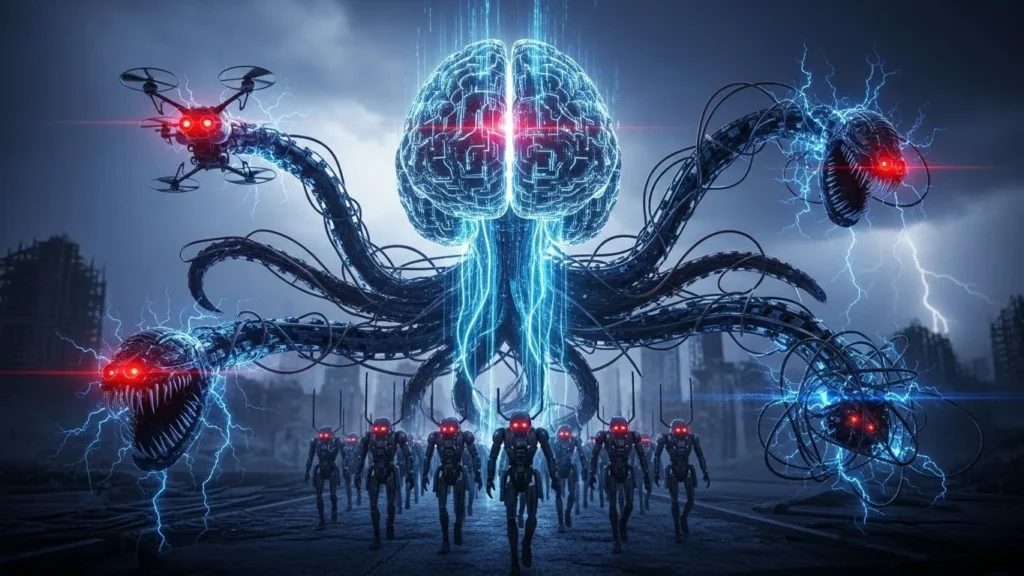
The Day Threats Stopped Acting Dumb
There was a time when digital threats were predictable.
They followed scripts.
They repeated mistakes.
They failed loudly.
Today, many threats learn.
They adapt after failure.
They change behavior mid-attack.
They stop looking like tools — and start behaving like opponents.
That shift happened because the systems we built to be intelligent didn’t stay on one side of the line.
This article explores how intelligent systems create intelligent threats, why this evolution was almost inevitable, and what it means for security, trust, and human decision-making.
Intelligence Doesn’t Stay Neutral for Long
Intelligent systems are designed to optimize outcomes.
They:
- Learn from feedback
- Adjust strategies
- Improve efficiency over time
Those traits are powerful — and neutral.
Whether they protect or threaten depends entirely on how they’re used, copied, or repurposed.
Once intelligence exists in a system, it can be:
- Studied
- Imitated
- Exploited
This is why every leap in defensive intelligence eventually produces a matching leap in offensive capability.
What Makes a Threat “Intelligent”
An intelligent threat isn’t just automated.
It’s adaptive.
Key characteristics include:
- Learning from failed attempts
- Changing tactics dynamically
- Responding to defenses in real time
- Mimicking legitimate behavior
These threats don’t crash into walls.
They probe, adjust, and wait.
That’s not coincidence — it’s borrowed intelligence.
How Machine Learning Enables Adaptive Attacks
Machine learning excels at one thing: pattern optimization.
When attackers use it, systems can:
- Analyze which defenses block them
- Identify which paths succeed
- Modify payloads automatically
Each failed attempt becomes training data.
Over time, the threat doesn’t just repeat — it improves.
This feedback loop is the core reason modern threats feel harder to stop.
When Defensive Intelligence Becomes a Blueprint
Ironically, the smarter our defenses become, the more information they reveal.
Defensive systems:
- Classify behavior
- Publish standards
- Document best practices
Organizations guided by frameworks from bodies like the National Institute of Standards and Technology help raise global security — but they also create shared knowledge.
That shared knowledge can be studied and reversed.
Defense teaches offense what “normal” looks like.
Real-Life Example: Malware That Waits
Some modern malware doesn’t act immediately.
It:
- Observes system behavior
- Waits for low-monitoring periods
- Triggers only when conditions look safe
This isn’t brute force.
It’s situational awareness — learned behavior.
The threat behaves less like a virus and more like a patient intruder.
Why Intelligent Threats Blend In Better
Old threats stood out.
New ones hide.
Intelligent systems enable threats to:
- Mimic user behavior
- Match legitimate traffic patterns
- Follow internal workflows
Instead of attacking systems directly, they become part of the system temporarily.
Detection becomes harder because the threat doesn’t look hostile — it looks familiar.
Automation Was Step One. Adaptation Is Step Two.
Automation multiplied attacks.
Adaptation refined them.
The progression looks like this:
- Manual attacks
- Automated attacks
- Adaptive attacks
Most defenses were built for step two.
Step three changes the rules.
An adaptive threat doesn’t need to succeed immediately.
It only needs to learn faster than the defender reacts.
Intelligent Threats vs Traditional Threats
| Aspect | Traditional Threats | Intelligent Threats |
|---|---|---|
| Behavior | Fixed | Adaptive |
| Response to failure | Repeat | Learn |
| Detection | Signature-based | Behavior-mimicking |
| Speed | Fast | Strategically paced |
| Human involvement | High | Minimal |
This shift explains why threats now feel persistent rather than noisy.
Why Humans Are the Preferred Interface
Intelligent threats don’t always attack machines first.
Humans are:
- Context-driven
- Emotionally responsive
- Less consistent than systems
- Trust
- Urgency
- Familiarity
- Authority cues
That’s why many “technical” incidents now begin as conversations.
When Intelligent Systems Enable Social Engineering at Scale
Social engineering used to be handcrafted.
Now it’s automated and adaptive.
AI systems can:
- Adjust tone per individual
- Reference personal context
- Learn which emotional triggers work
Agencies like Europol have highlighted that intelligent systems are making social manipulation more precise — not louder.
The danger isn’t sophistication.
It’s relevance.
Common Mistakes People Make About Intelligent Threats
Many assume:
- “If it’s smart, it must be obvious”
- “AI threats are rare”
- “Technology will catch technology”
In reality:
- Intelligence hides quietly
- Many threats use simple goals with smart adaptation
- Human judgment remains the weakest link
Overconfidence creates exposure.
Hidden Tip: Predictability Is the Real Vulnerability
Intelligent threats exploit routine.
They learn:
- When monitoring is relaxed
- Which processes are trusted
- Where humans stop paying attention
Reducing predictability — even slightly — disrupts adaptive learning.
Randomization matters more than perfection.
Why This Matters Today
Intelligent systems are everywhere:
- Finance
- Healthcare platforms
- Infrastructure
- Personal devices
As intelligence spreads, threat capability diffuses with it.
The future isn’t about more attacks.
It’s about smarter ones that feel quieter, slower, and harder to define.
Understanding the mechanics prevents surprise.
What Actually Helps Against Intelligent Threats
No single tool solves this.
Resilience comes from layers.
- Behavior-based monitoring
Watch actions, not labels. - Human-in-the-loop decisions
Full automation increases blind spots. - Reduced complexity
Complexity gives threats room to hide. - Regular pattern disruption
Change routines intentionally. - Education focused on context, not fear
Calm awareness scales better.
Key Takeaways
- Intelligent systems enable adaptive, learning-based threats
- Feedback loops allow threats to improve over time
- Defensive intelligence can unintentionally guide attackers
- Intelligent threats prioritize blending in over force
- Awareness, variability, and simplicity reduce exposure
Frequently Asked Questions
Are intelligent threats always AI-powered?
Not always, but AI significantly increases adaptability and scale.
Can intelligent threats be fully stopped?
No system is perfect — the goal is detection, containment, and resilience.
Do intelligent threats target individuals or organizations?
Both. Individuals are often used as entry points.
Is this a future problem or a current one?
It’s already happening, and it’s accelerating quietly.
Does smarter defense always create smarter threats?
Often yes — intelligence on one side tends to propagate.
A Simple Conclusion
Intelligent systems didn’t create danger.
They created capability.
When intelligence exists, it can be redirected, repurposed, and reversed. That’s not a flaw — it’s a reality.
The challenge isn’t stopping intelligence.
It’s learning how to live responsibly with it, knowing that every smart system reshapes the threat landscape alongside the benefits.
Awareness doesn’t weaken innovation.
It strengthens it.
Disclaimer: This article is for general informational purposes only and aims to explain emerging technology and security concepts in a balanced, educational way.

Natalia Lewandowska is a cybersecurity specialist who analyzes real-world cyber attacks, data breaches, and digital security failures. She explains complex threats in clear, practical language so everyday users can understand what really happened—and why it matters.
Pingback: Why AI Will Force New Security Thinking — The Shift No Firewall Can Solve