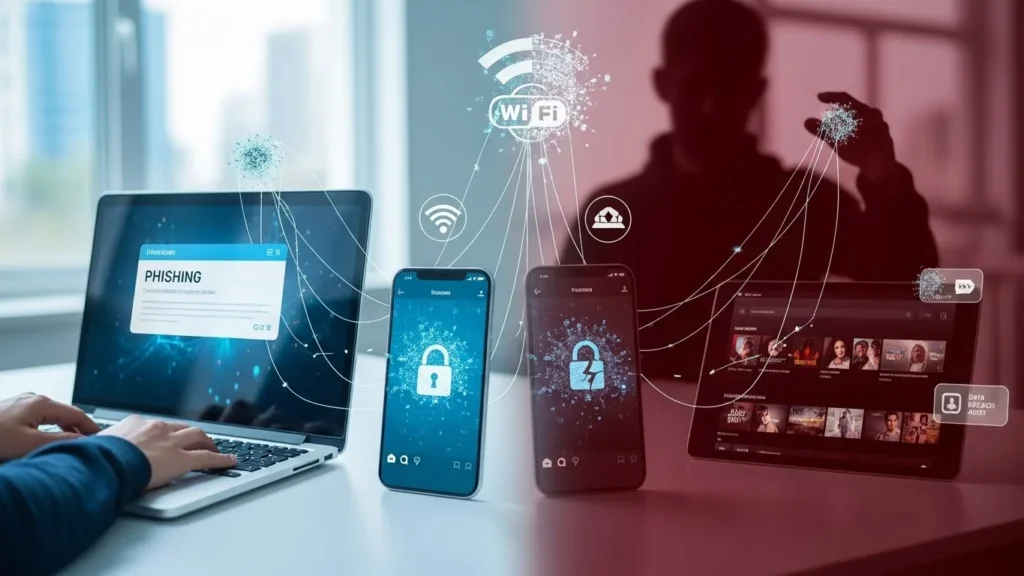
The Danger You Don’t Feel Coming
Think about the last time you felt genuinely alert online.
Not annoyed.
Not rushed.
Actually cautious.
For most people, that moment is rare.
Today’s cyber threats don’t arrive with flashing red warnings or dramatic system crashes. They arrive as ordinary moments—a familiar login screen, a routine email, a helpful pop-up, a convenient app permission.
Nothing feels wrong.
And that’s exactly the problem.
Modern cyber threats are designed to blend seamlessly into everyday online life, hiding behind habits, familiarity, and trust. By the time something feels off, the damage is often already done.
How “Normal” Became the Most Powerful Attack Vector
Early internet threats looked suspicious.
Broken English emails.
Strange links.
Obvious scams.
People learned to spot them.
So attackers adapted.
Today, threats succeed not by standing out—but by looking exactly like what we expect.
They copy:
- Interfaces we trust
- Brands we recognize
- Behaviors we perform daily
The more normal something feels, the less attention we give it.
This shift has quietly changed the entire security landscape.
Everyday Online Moments That Carry Hidden Risk
Most people imagine cyber threats as rare events.
In reality, they’re woven into routine actions.
Consider how often you:
- Log into accounts
- Click links
- Accept permissions
- Download updates
- Sync devices
Each action is small. Each feels harmless.
But attackers design threats specifically to hide inside these ordinary flows.
When Convenience Becomes the Cover
Convenience is one of the biggest enablers of modern cyber risk.
We value:
- Speed over scrutiny
- Ease over verification
- Familiarity over caution
This is why phishing emails now resemble real receipts, shipping updates, and account notifications from companies like Amazon or Google.
They don’t interrupt your day.
They fit into it.
And fitting in is what makes them effective.
The Psychology That Keeps Threats Invisible
Cybersecurity failures are rarely technical alone. They’re behavioral.
Key human tendencies attackers exploit:
- Pattern recognition – we stop checking things that look familiar
- Cognitive overload – too many decisions lead to shortcuts
- Trust transfer – we trust visuals instead of verifying sources
- Routine bias – repeated actions stop feeling risky
Over time, caution fades not because people are careless—but because their brains adapt to digital repetition.
Real-Life Examples That Feel Too Ordinary
The Login Page That Wasn’t
A cloned login screen that looks identical to your usual one can harvest credentials without raising suspicion—especially when accessed via a routine email or message.
The App That Asked for “One More Permission”
Many apps request access that exceeds their function. Once granted, data collection continues quietly in the background.
The “Security Check” Message
Messages claiming unusual activity often push users to “verify now.” The urgency feels familiar because legitimate platforms use similar language.
None of these feel like attacks.
They feel like Tuesday.
Why Cyber Threats Thrive in Familiar Environments
Attackers don’t want your attention.
They want your automatic behavior.
The safest-looking environments are often the most dangerous because:
- Users stop questioning them
- Trust replaces verification
- Speed overrides reflection
This is why threats embedded in social platforms like Facebook or messaging apps spread faster than obvious scams ever could.
Old Cyber Threats vs Modern Blended Threats
| Aspect | Traditional Threats | Modern Blended Threats |
|---|---|---|
| Appearance | Suspicious | Familiar |
| Timing | Random | Perfectly timed |
| Delivery | Obvious scams | Routine messages |
| Detection | Easier | Harder |
| User reaction | Caution | Automatic trust |
The danger didn’t increase because technology got worse.
It increased because threats learned to look like everyday life.
Why This Matters More Than Most People Realize
Digital life is no longer optional.
Work.
Banking.
Healthcare.
Relationships.
When cyber threats blend into daily routines, everyone becomes a target, not because they’re important—but because they’re predictable.
The average person doesn’t need to be hacked directly. Their data, accounts, or behavior can be leveraged indirectly, quietly, and repeatedly.
And the scariest part?
Most victims never realize when the breach actually happened.
Common Mistakes That Keep Threats Invisible
Even cautious users fall into patterns that increase risk.
Mistakes to avoid:
- Clicking first and thinking later
- Trusting visuals over URLs
- Reusing passwords across platforms
- Ignoring small inconsistencies
- Assuming “nothing happened” means “nothing’s wrong”
Cyber threats rely on delayed consequences.
Silence isn’t safety.
Small Habits That Make a Big Difference
You don’t need to live in fear to stay safer.
What helps is slowing down just enough to notice patterns breaking.
Actionable steps:
- Pause before clicking unexpected messages
- Check URLs, not logos
- Limit app permissions regularly
- Use unique passwords with a manager
- Treat urgency as a signal, not a command
Security isn’t about suspicion—it’s about attention.
The Invisible Shift That Protects You
People who stay safer online don’t know more secrets.
They notice when something feels slightly off in an otherwise normal moment.
That pause—before clicking, logging in, or approving—breaks the spell that blended threats rely on.
Once you see how risks hide inside routine, they become easier to spot.
Key Takeaways
- Modern cyber threats are designed to look normal
- Familiarity lowers our natural defenses
- Convenience often hides risk
- Small daily actions carry cumulative exposure
- Awareness, not fear, is the strongest protection
Frequently Asked Questions
1. Why don’t cyber threats look suspicious anymore?
Because attackers learned that familiarity lowers caution. Blending in is more effective than standing out.
2. Are regular users really targeted?
Yes. Most attacks aim for scale, not importance. Predictable behavior is more valuable than high status.
3. Is technology getting less secure?
Not necessarily. Human habits haven’t evolved as fast as digital environments.
4. What’s the biggest mistake people make online?
Relying on appearance instead of verification—trusting how something looks rather than where it comes from.
5. Can simple habits really reduce risk?
Absolutely. Small pauses and checks disrupt most blended attacks.
Conclusion: The Quietest Threats Are the Most Successful
Cyber threats don’t announce themselves anymore.
They sit inside emails that look normal.
Apps that feel helpful.
Messages that fit your day perfectly.
The goal isn’t to disconnect from digital life.
It’s to stay just aware enough to notice when “normal” isn’t quite right.
That awareness turns invisible threats visible—and restores control where it matters most.
Disclaimer: This article is for general informational purposes only and is not a substitute for professional cybersecurity assessment or advice.

Natalia Lewandowska is a cybersecurity specialist who analyzes real-world cyber attacks, data breaches, and digital security failures. She explains complex threats in clear, practical language so everyday users can understand what really happened—and why it matters.
Pingback: Why Modern Viruses Are Hard to Detect — The Invisible Threats Slipping Past Today’s Security