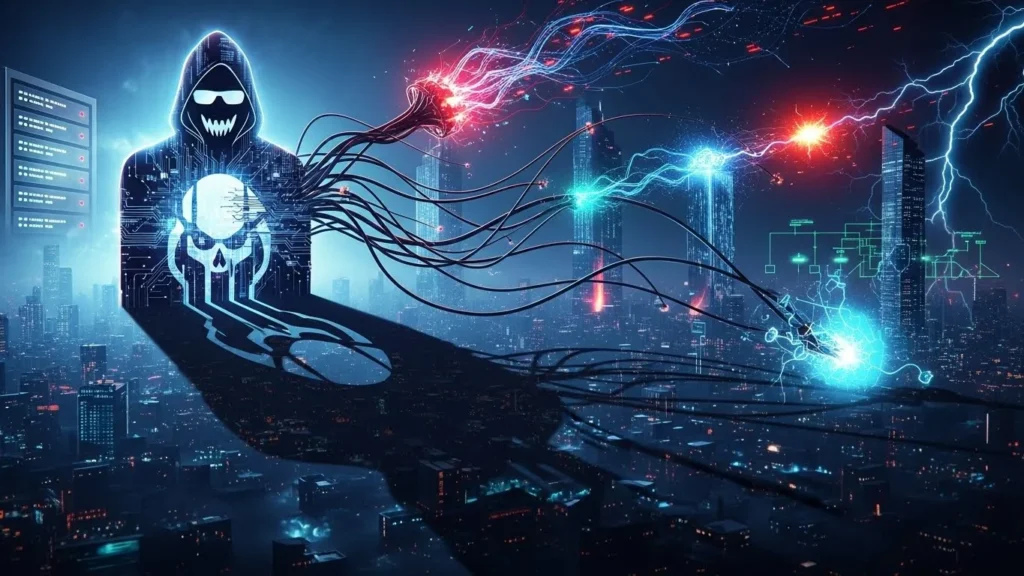
The Moment Cyber Attacks Became Smarter Than Humans
For decades, cyber attacks followed patterns.
They were repetitive.
They were imperfect.
They relied on human effort.
You could spot them if you paid attention.
Then something changed.
Cyber attacks started adapting.
Learning.
Improving on their own.
That moment marked the quiet arrival of artificial intelligence in cybercrime—and from that point on, digital threats stopped behaving like tools and started behaving like systems.
This isn’t a temporary trend.
It’s a permanent transformation.
Why Traditional Cyber Attacks Had Limits
Before AI, cyber attacks were constrained by humans.
Attackers had to:
- Manually craft phishing emails
- Reuse attack templates
- Guess targets and timing
- Scale slowly
Even large attacks required effort, coordination, and time.
That created friction.
And friction created opportunities for detection, mistakes, and defense.
AI removed much of that friction.
How AI Quietly Removed the Weakest Link in Cybercrime
Humans are slow.
Humans get tired.
Humans make errors.
AI does none of that.
With AI, attackers can now:
- Generate thousands of unique attack messages instantly
- Personalize content based on public data
- Adapt tactics after each failed attempt
- Run attacks continuously without rest
The most important shift?
Cyber attacks no longer need creativity or intuition from humans.
AI supplies both—at scale.
The Rise of Hyper-Personalized Attacks
One of the most dangerous changes AI introduced is personalization.
Older attacks were generic.
“Dear user.”
“Your account has an issue.”
Easy to spot.
AI-powered attacks analyze:
- Social media posts
- Online profiles
- Writing styles
- Public interactions
Then they generate messages that sound familiar, relevant, and timely.
The attack doesn’t feel suspicious.
It feels expected.
Real-Life Example: When Phishing Feels Personal
Imagine receiving an email that:
- Uses your real name
- Mentions your workplace
- References a recent event
- Matches how your colleague writes
There’s no spelling error.
No urgency trigger.
No obvious red flag.
That’s not luck.
That’s AI-driven reconnaissance and generation working together.
Why This Matters Today (Even for Smart Users)
Cybersecurity advice often says:
“Be careful.”
AI makes that harder.
Because careful users rely on context, familiarity, and tone to judge safety.
AI attacks exploit those exact signals.
This means:
- Awareness alone isn’t enough
- Experience doesn’t guarantee protection
- Even experts can be fooled
AI attacks don’t look like attacks.
They look like normal digital life.
Automation Changed the Scale of Cybercrime
Before AI, scale required people.
Now, scale requires computation.
AI allows attackers to:
- Test millions of variations
- Learn what works fastest
- Optimize success rates automatically
Every failed attempt improves the next one.
Cyber attacks are no longer static.
They’re self-improving systems.
The Shift From Random Targets to Precise Selection
AI doesn’t attack blindly.
It prioritizes.
It identifies:
- Who is most likely to respond
- When they are most vulnerable
- Which message style works best
This precision reduces noise—and increases success.
The result?
Fewer obvious attacks.
More effective ones.
A Clear Comparison: Pre-AI vs AI-Driven Attacks
| Traditional Cyber Attacks | AI-Driven Cyber Attacks |
|---|---|
| Generic messages | Personalized content |
| Manual execution | Automated at scale |
| Static techniques | Adaptive learning |
| Easy to pattern-match | Constantly changing |
| Human-limited | Machine-accelerated |
This is why old defense assumptions break down.
Deepfakes Changed Trust Forever
AI didn’t just improve text-based attacks.
It introduced deepfakes.
Now attackers can generate:
- Fake voice messages
- Synthetic video calls
- Realistic impersonations
These attacks bypass skepticism by using sensory trust.
If you hear a voice you recognize, your brain lowers defenses.
That biological shortcut is now being exploited digitally.
The Most Common Mistakes People Still Make
Despite the shift, many users and organizations still:
- Look for spelling errors
- Expect urgency cues
- Trust familiar formats
- Rely on “common sense”
These worked before AI.
They’re unreliable now.
The biggest mistake?
Assuming attacks will look suspicious.
Hidden Insight: AI Attacks Optimize for Believability, Not Speed
Older attacks relied on urgency.
AI attacks often rely on patience.
They wait.
They build context.
They strike when trust is highest.
Slower—but far more effective.
How Defenders Are Responding (And Why It’s Hard)
Security teams are also using AI.
But defense has a disadvantage:
- Attackers only need one success
- Defenders must block everything
AI amplifies both sides—but asymmetry remains.
That’s why future defense strategies focus less on stopping every attack and more on limiting damage and recovery.
Practical Steps to Adapt to AI-Driven Threats
You can’t outsmart AI with intuition.
You need structure.
Start here:
- Verify through separate channels
Never trust a single digital signal. - Slow down trust-based decisions
Payments and access deserve pauses. - Assume realism doesn’t equal legitimacy
Professional appearance means nothing now. - Reduce public data exposure
Less data means weaker personalization. - Design for failure, not perfection
Assume something will slip through.
These habits matter more than tools alone.
Why AI Makes Cybersecurity a Human Problem Again
Ironically, AI returns security to human fundamentals.
Not technical brilliance—but:
- Judgment
- Process
- Discipline
- Verification
AI beats humans at speed and scale.
Humans still win at intentional decision-making—when systems support them.
Key Takeaways
- AI permanently changed how cyber attacks operate
- Attacks are now adaptive, personalized, and scalable
- Familiarity and realism can no longer be trusted
- Awareness alone is insufficient protection
- Verification and structure are the new defenses
Frequently Asked Questions
1. Are AI cyber attacks unstoppable?
No—but they require different defense strategies focused on resilience.
2. Does this mean phishing will disappear?
No. It will become more sophisticated and harder to detect.
3. Can individuals protect themselves from AI attacks?
Yes—through verification habits and reduced data exposure.
4. Will AI make cybersecurity tools obsolete?
No. It changes how tools must operate and integrate.
5. Is this shift temporary?
No. AI-driven attacks represent a permanent evolution.
A Calm, Honest Conclusion
AI didn’t make cyber attacks more dangerous by accident.
It made them smarter by design.
From this point forward, attacks will adapt, learn, and personalize automatically.
That doesn’t mean panic is necessary.
It means assumptions must change.
The safest people in the future won’t be the most technical.
They’ll be the most intentional—about trust, verification, and recovery.
Because when AI reshapes threats forever, clarity becomes the strongest defense.
Disclaimer: This article is for general educational purposes only and discusses broad cybersecurity trends, not specific security or technical advice.

Natalia Lewandowska is a cybersecurity specialist who analyzes real-world cyber attacks, data breaches, and digital security failures. She explains complex threats in clear, practical language so everyday users can understand what really happened—and why it matters.