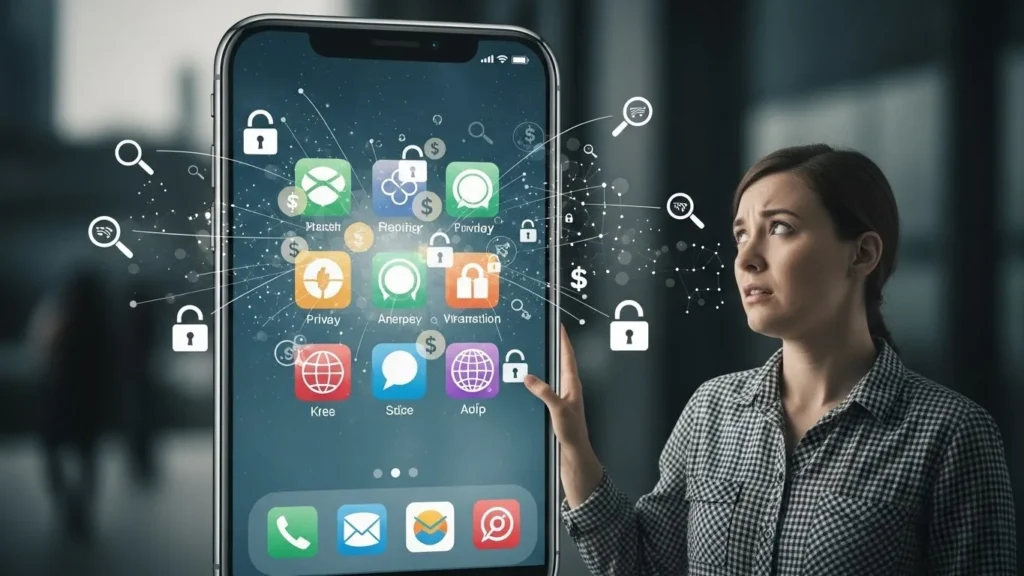
The moment everyone has experienced—but rarely questions
You download an app.
No payment screen.
No card details.
No subscription prompt.
It feels like a win.
But within days, something changes:
- Ads suddenly feel uncannily relevant
- Your feed adapts faster than expected
- Recommendations feel personal—almost intimate
That’s when the truth quietly settles in.
You didn’t pay with money.
You paid with something far more valuable.
The Simple Rule of Business Most People Forget
Apps cost money to build, maintain, and improve.
Servers.
Engineers.
Designers.
Security.
Updates.
So ask the uncomfortable question:
If you’re not paying… who is?
The answer isn’t advertisers alone.
And it isn’t data in the abstract.
It’s you—your behavior, attention, and patterns.
Free apps don’t sell products.
They sell predictability.
The Real Business Model Behind “Free”
Most free apps operate on one or more of these models:
- Advertising-driven platforms
- Data collection and resale
- Behavioral profiling
- Freemium conversion funnels
- Ecosystem lock-in
Some use all five simultaneously.
Companies like Google, Meta, and Apple didn’t become trillion-dollar businesses by giving value away for nothing.
They monetized attention and insight at scale.
What You’re Really Paying With (Beyond Data)
Most people hear “data” and think:
- Name
- Location
That’s only the surface.
Free apps collect and infer:
- How long you pause on content
- What you scroll past quickly
- When you’re bored, stressed, or curious
- What influences your decisions
This is behavioral intelligence, not just information.
And it’s far more valuable than raw data.
Attention: The Most Expensive Currency You Own
Every minute spent inside an app has a cost.
Free apps are engineered to:
- Keep you scrolling
- Reduce exit points
- Trigger emotional loops
- Capture fragmented attention
This isn’t accidental design.
It’s the result of:
- A/B testing
- Behavioral psychology
- Reward-based feedback loops
Your time funds the platform—quietly, continuously.
Why “Personalization” Is a Trade-Off, Not a Gift
Personalized feeds feel helpful.
Until they aren’t.
Behind personalization:
- Algorithms test emotional responses
- Content is ranked by engagement, not value
- Extremes outperform balance
What starts as convenience becomes:
- Narrowed perspectives
- Reinforced habits
- Subtle influence on decisions
The price isn’t just privacy—it’s autonomy.
Free vs Paid Apps: A Clear Comparison
| Aspect | Free Apps | Paid Apps |
|---|---|---|
| Revenue Source | Ads, data, attention | Direct payment |
| Data Collection | Extensive | Minimal |
| Incentive | Keep you engaged | Serve you efficiently |
| Transparency | Often unclear | Usually clearer |
| Long-term Cost | Hidden | Known upfront |
This doesn’t mean paid apps are perfect.
But the incentives are fundamentally different.
Why This Matters Today (Even If You’re “Careful”)
Modern life runs on apps:
- Banking
- Health tracking
- Navigation
- Communication
- Work
When most of them are free, surveillance becomes normalized.
Not malicious surveillance.
But ambient, invisible, and constant.
Over time, this shapes:
- What you see
- What you buy
- What you believe
- What you avoid
That’s a powerful influence to ignore.
The Biggest Myths People Still Believe
Myth 1: “I have nothing to hide.”
Privacy isn’t about secrets. It’s about choice.
Myth 2: “It’s anonymous.”
Behavioral patterns are often more identifiable than names.
Myth 3: “Settings fix everything.”
They help—but they don’t change business models.
Myth 4: “Free apps help small users.”
They help platforms scale, not users stay independent.
Real-Life Example: The Free Fitness App
A fitness app tracks:
- Steps
- Sleep
- Location
- Workout timing
On its own, harmless.
Combined:
- Daily routines become clear
- Stress patterns emerge
- Lifestyle segments are inferred
That data becomes valuable for:
- Insurance risk models
- Advertising profiles
- Behavioral research
You didn’t pay money—but the insights weren’t free.
Mistakes Most Users Make (Without Knowing)
- Installing apps “just to try”
- Ignoring permission creep after updates
- Allowing background activity by default
- Assuming deletion erases history
- Trusting vague privacy policies
These aren’t careless users.
They’re normal ones.
What You Can Do (Without Becoming Extreme)
You don’t need to delete every app.
You do need to be intentional.
Practical steps that actually help:
- Prefer paid tools for critical tasks
- Limit app permissions aggressively
- Use web versions when possible
- Audit apps every few months
- Ask: “Why does this need this data?”
Awareness reduces exploitation—even inside imperfect systems.
Why Some Free Apps Are Still Worth Using
Not all free apps are villains.
Some offer:
- Genuine public value
- Open-source transparency
- Clear trade-offs
The issue isn’t “free.”
It’s undeclared cost.
Trust grows when exchanges are honest.
Key Takeaways
- Free apps are funded by attention, behavior, and data
- You pay with predictability—not money
- Personalization is a trade-off, not a gift
- Business incentives shape user experience
- Conscious choices reduce hidden costs
Frequently Asked Questions
Are paid apps completely private?
No—but they usually collect less and rely less on behavioral monetization.
Can free apps sell my data directly?
Sometimes, but more often they sell insights, segments, or access—not raw files.
Do app permissions really matter?
Yes. They limit exposure—but don’t override business incentives.
Is this legal?
Most practices operate within existing regulations, though transparency varies.
Should I stop using free apps entirely?
No. Use them knowingly, not automatically.
A Calm, Honest Conclusion
Free apps didn’t trick you.
They offered a deal.
The problem is most people never saw the terms.
When you understand the real price, you regain choice.
And choice—more than privacy—is what truly matters.
Disclaimer: This article is for general educational awareness and reflects common digital business practices that may vary by platform and region.

Natalia Lewandowska is a cybersecurity specialist who analyzes real-world cyber attacks, data breaches, and digital security failures. She explains complex threats in clear, practical language so everyday users can understand what really happened—and why it matters.
Pingback: The Hidden Permissions Apps Quietly Use Against You — And How to Take Back Control
Pingback: Free Wi-Fi Isn’t Free: The Hidden Privacy Risk Behind Public Networks Most People Miss
Pingback: How Your Offline Data Becomes Online Data — The Invisible Pipeline Tracking Real Life