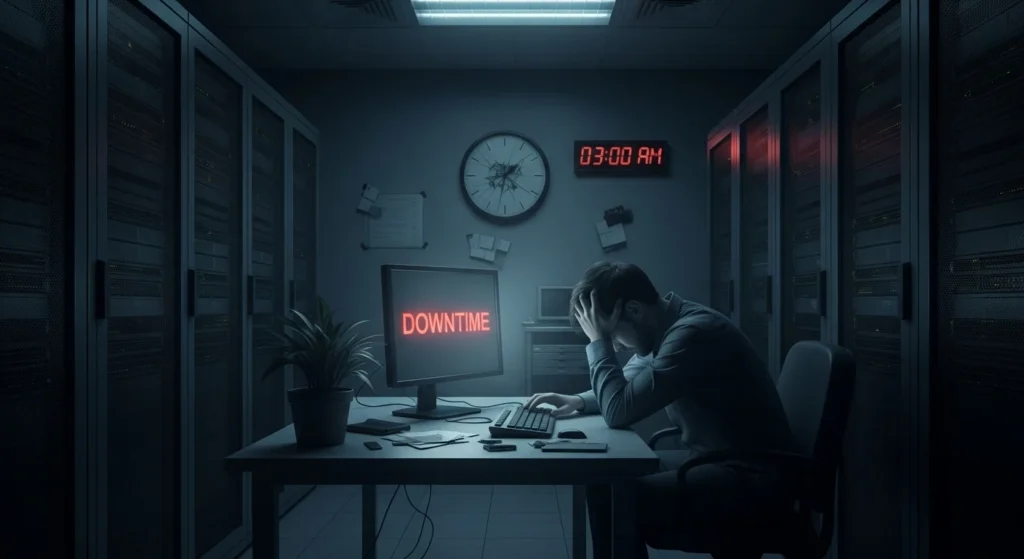
When Everything Stops, Money Starts Leaking
Most businesses don’t collapse because of a cyberattack.
They bleed.
Slowly. Quietly. Repeatedly.
A system goes down. Orders pause. Employees wait. Customers refresh their screens. Partners lose confidence. Revenue slips—not all at once, but in steady, compounding waves.
Downtime from cyber incidents isn’t just an IT problem.
It’s a direct revenue drain, and often the most expensive part of a breach isn’t the ransom, the fine, or the headline.
It’s the time when nothing works.
And the longer it lasts, the deeper the financial damage goes—often in ways companies don’t measure until it’s too late.
What “Downtime” Really Means in a Cyber Incident
When people hear “downtime,” they often picture servers offline.
In reality, downtime is broader—and more damaging.
It includes:
- Inaccessible websites or apps
- Frozen payment systems
- Locked internal tools and databases
- Employees unable to work
- Customer support disruptions
- Delayed supply chains and logistics
Cyber downtime isn’t just about systems being unavailable.
It’s about business operations grinding to a halt.
Even partial outages can create full-scale financial consequences.
Why Downtime Hits Revenue Faster Than Data Loss
Data loss feels scary. Downtime feels temporary.
But from a revenue perspective, downtime is often worse.
Here’s why:
- Sales stop immediately
- Productivity drops across departments
- Customer trust erodes in real time
- Contracts and SLAs are breached
- Recovery costs escalate by the hour
A data breach might be discovered weeks later.
Downtime hits right now.
And revenue doesn’t wait.
The Real Revenue Drains Hidden Inside Downtime
1. Lost Sales You Never Get Back
Every minute your systems are down, customers move on.
They don’t wait patiently.
They buy elsewhere.
E-commerce platforms, SaaS companies, financial services, and marketplaces are especially vulnerable because downtime equals zero transactions.
Even after recovery, many of those customers don’t return.
The loss isn’t temporary—it’s permanent.
2. Productivity Collapse Across the Organization
When systems go offline, employees don’t magically switch to manual mode.
Instead:
- Sales teams can’t access CRM tools
- Operations teams can’t process orders
- Finance can’t invoice or reconcile
- Support teams can’t see customer data
Payroll still runs. Salaries still get paid.
But output drops sharply.
That gap between cost and productivity is a silent revenue leak.
3. SLA Penalties and Contractual Losses
Downtime often triggers:
- Missed service-level agreements
- Financial penalties
- Refund obligations
- Contract renegotiations
For B2B companies, this can snowball fast.
One outage can strain multiple client relationships—and future renewals quietly disappear.
4. Customer Trust Damage That Reduces Lifetime Value
Customers don’t always complain loudly.
Sometimes they just leave.
Downtime signals instability—even if security is restored quickly.
Over time, this leads to:
- Lower repeat purchases
- Reduced subscription renewals
- Higher churn rates
- Increased price sensitivity
Trust erosion is subtle, but its revenue impact compounds month after month.
Real-World Examples That Reveal the True Cost
Consider well-documented cyber incidents:
- Maersk lost hundreds of millions after the NotPetya attack disrupted operations worldwide. The biggest cost wasn’t stolen data—it was halted logistics.
- Equifax faced massive long-term revenue damage due to operational disruption and trust loss, not just fines.
In both cases, downtime amplified every other cost.
Downtime Costs: Small Businesses vs Large Enterprises
Downtime doesn’t discriminate—but it hits differently.
| Business Type | Downtime Impact | Recovery Reality |
|---|---|---|
| Small Business | Immediate cash flow loss | Often fatal if prolonged |
| Mid-Size Company | Operational paralysis | Slow, expensive recovery |
| Enterprise | Massive scale losses | Long reputational recovery |
For smaller companies, even hours of downtime can threaten survival.
For large organizations, the losses are larger—but so is public scrutiny.
Why Cyber Downtime Is Getting More Expensive Over Time
Downtime today costs more than it did a decade ago because:
- Businesses are more digitally dependent
- Systems are more interconnected
- Customers expect instant availability
- Attackers target operations, not just data
Ransomware groups now design attacks specifically to maximize downtime pressure.
They know revenue pain forces faster decisions.
Common Mistakes That Make Downtime Worse
Many companies unintentionally extend downtime by:
- Lacking clear incident response plans
- Underestimating backup recovery time
- Poor internal communication during incidents
- Delayed decision-making due to confusion
- Treating cybersecurity as an IT issue only
The longer leadership hesitates, the more revenue slips away.
Hidden Tip: Downtime Often Continues After Systems Are “Back”
This is rarely discussed.
Even after technical recovery:
- Employees work slower
- Customers remain cautious
- Processes need validation
- Teams divert time to audits and reviews
Operational “normal” can take weeks—or months—to fully return.
Revenue recovery lags behind system recovery.
Actionable Steps to Reduce Revenue Loss From Downtime
You can’t eliminate cyber risk—but you can limit downtime damage.
Practical actions that matter:
- Map revenue-critical systems first
Know which outages hurt cash flow the fastest. - Practice downtime scenarios
Tabletop exercises reduce hesitation during real incidents. - Invest in rapid recovery, not just prevention
Backups are useless if restoration is slow. - Align leadership on decision authority
Delays cost more than imperfect choices. - Communicate clearly with customers early
Silence increases churn.
Downtime resilience is a business strategy—not just a security upgrade.
Why This Matters Today (and Always Will)
As businesses become more digital, downtime becomes more expensive.
Cyber incidents no longer need to steal data to cause damage.
They just need to stop your business from running.
And while attackers innovate, revenue pressure remains constant.
Understanding downtime as a financial risk, not just a technical one, is what separates resilient companies from vulnerable ones.
Key Takeaways
- Cyber downtime is one of the fastest ways revenue drains
- Lost sales, productivity, and trust compound silently
- Downtime often costs more than data theft
- Recovery takes longer than most businesses expect
- Planning for downtime resilience protects profits—not just systems
Frequently Asked Questions (FAQ)
1. How long does cyber downtime usually last?
It ranges from hours to weeks, depending on preparedness, system complexity, and decision speed during the incident.
2. Is downtime more expensive than paying a ransom?
Often yes. Downtime impacts revenue, productivity, trust, and future sales—far beyond the immediate ransom amount.
3. Can cyber insurance fully cover downtime losses?
Insurance may help, but it rarely covers long-term revenue erosion or customer trust damage.
4. Which industries suffer the most from downtime?
E-commerce, finance, healthcare, logistics, and SaaS companies face the highest immediate revenue impact.
5. What’s the fastest way to reduce downtime risk?
Prioritizing recovery planning, clear leadership roles, and regular incident simulations significantly reduce downtime duration.
Conclusion: Downtime Is a Business Crisis, Not a Technical Glitch
Cyber incidents don’t have to destroy a company to damage it deeply.
All they need is time.
Time when systems are down.
Time when customers wait.
Time when revenue quietly slips away.
The businesses that survive aren’t the ones that never get attacked.
They’re the ones that understand downtime—and plan for it like their revenue depends on it.
Because it does.
Disclaimer: This article is for informational purposes only and reflects general industry knowledge, not specific legal or financial advice.

Natalia Lewandowska is a cybersecurity specialist who analyzes real-world cyber attacks, data breaches, and digital security failures. She explains complex threats in clear, practical language so everyday users can understand what really happened—and why it matters.
Pingback: How Cybercrime Quietly Disrupts Cash Flow—and Why the Damage Lasts Longer Than You Think