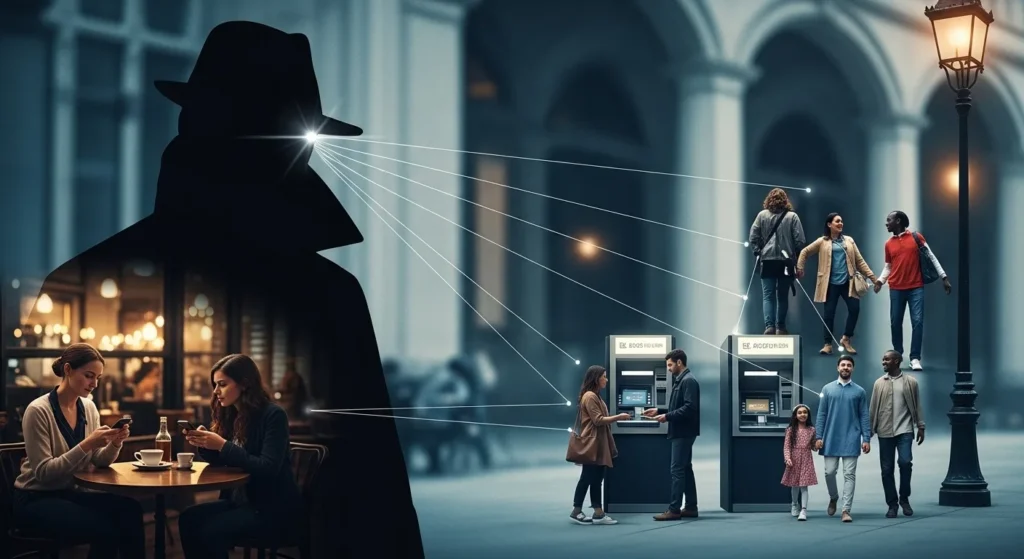
It starts small.
A doorbell camera to feel safer.
Face ID to unlock your phone faster.
A smart assistant to turn off the lights.
A location app to find the quickest route home.
Nothing feels intrusive.
In fact, it feels helpful.
That’s the powerful reality of modern surveillance:
It rarely arrives as control. It arrives as convenience.
And that’s exactly why surveillance is expanding faster than most people ever expected.
Not because society demanded it…
But because we welcomed it.
Let’s explore how comfort, speed, and digital simplicity are quietly reshaping privacy, cybersecurity, and the boundaries of being watched.
Surveillance Didn’t Become Normal Overnight
Surveillance used to be obvious.
- CCTV cameras in banks
- Security checks at airports
- Police monitoring high-risk areas
It felt limited. Visible. Controlled.
But today’s surveillance is different.
It’s woven into everyday life through:
- Smartphones
- Smart homes
- Apps
- Wearables
- Connected cities
- AI systems
The shift is subtle:
Surveillance no longer looks like spying. It looks like service.
Why Convenience Is the Perfect Gateway
Convenience removes friction.
And friction is what once protected privacy.
Think about it:
Before digital life, tracking someone required real effort.
Now?
Tracking is automated, instant, and invisible.
Convenience makes surveillance easy to accept because it comes with benefits like:
- Faster access
- Personalized experiences
- Automated safety
- Seamless payments
- Real-time recommendations
The tradeoff feels small.
But the long-term impact is huge.
The Invisible Deal We’re All Making
Every time we choose convenience, we often exchange something:
But it doesn’t feel like a transaction.
No one says:
“Would you like comfort in exchange for constant monitoring?”
Instead, it sounds like:
- “Allow location for better service.”
- “Enable camera access to continue.”
- “Accept cookies for improved experience.”
The surveillance economy works best when you don’t notice it.
Everyday Convenience That Expands Surveillance
Let’s break down the most common examples.
1. Smartphones: The Ultimate Surveillance Device
Your phone is convenient… and incredibly revealing.
It knows:
- Where you go
- Who you talk to
- What you search
- What you buy
- How long you sleep
- What you watch
Smartphones centralize surveillance because they never leave your side.
Even basic apps collect:
- Location metadata
- Device identifiers
- Browsing behavior
- Movement patterns
Convenience makes phones indispensable.
And surveillance makes them powerful.
2. Smart Homes: Comfort That Listens
Smart speakers, thermostats, cameras, locks…
Smart homes offer:
- Automation
- Security
- Energy savings
- Comfort
But they also create indoor surveillance networks.
Devices may capture:
- Voice recordings
- Activity patterns
- Visitors
- Daily routines
Hidden tip:
Your home data can be more valuable than your browser history.
Because it reveals how you live.
3. Wearables: Health Meets Monitoring
Fitness trackers feel personal and empowering.
But wearables collect:
- Heart rate trends
- Location during workouts
- Sleep cycles
- Stress indicators
This data can be shared with:
- App companies
- Advertisers
- Insurance systems
- Analytics firms
Convenience turns bodies into data streams.
4. Cashless Payments: Speed Over Anonymity
Tap-to-pay is fast.
But digital payments build financial surveillance trails.
Unlike cash, they log:
- Purchase history
- Location
- Time patterns
- Spending habits
Convenience reduces effort…
And eliminates anonymity.
5. Smart Cities: Surveillance as Infrastructure
Modern cities use surveillance technologies to manage:
- Traffic
- Crowds
- Crime prevention
- Emergency response
Tools include:
- AI-powered cameras
- Facial recognition
- Sensor networks
- License plate readers
Smart cities redefine surveillance because monitoring becomes embedded in public life.
You don’t opt in.
You exist inside it.
The Psychological Shift: Surveillance Feels Like Safety
One reason convenience expands surveillance is emotional:
People associate surveillance with protection.
- Cameras feel like security
- Tracking feels like control
- Monitoring feels like prevention
And sometimes it genuinely helps.
But the danger comes when surveillance grows without limits, oversight, or transparency.
Safety becomes the justification.
Convenience becomes the delivery.
Why Cybersecurity Experts Are Concerned
Surveillance expansion isn’t only a privacy issue.
It’s a cybersecurity issue.
Because surveillance systems create:
- Massive data collection
- Centralized databases
- High-value targets
- New attack surfaces
Hackers don’t just steal money anymore.
They steal:
- Biometric identity
- Movement history
- Citizen records
- Surveillance footage
The more surveillance grows, the more damaging breaches become.
The Biggest Mistakes People Make
Let’s talk about common misunderstandings.
Mistake 1: “I Have Nothing to Hide”
Privacy isn’t about hiding.
It’s about boundaries.
You may not fear being watched…
Until the watcher changes.
Privacy protects against future misuse, not current comfort.
Mistake 2: Trusting Convenience by Default
People assume:
“If it’s popular, it must be safe.”
But many systems prioritize speed to market over security.
Convenience often comes first.
Protection comes later.
Mistake 3: Ignoring Metadata
Even if companies don’t “listen” to content…
They track patterns.
Metadata reveals more than words.
It shows behavior.
And behavior is predictable.
Mistake 4: Clicking “Accept” Without Thinking
Consent fatigue is real.
Most people agree to tracking just to move forward.
Surveillance thrives in moments of impatience.
Actionable Steps to Protect Yourself
You don’t have to abandon technology.
But you can reduce unnecessary exposure.
Here are practical, realistic steps:
1. Audit App Permissions
Check which apps access:
- Location
- Microphone
- Camera
- Contacts
Remove what isn’t essential.
2. Use Privacy-Focused Browsing
- Block third-party cookies
- Use privacy extensions
- Avoid unnecessary tracking scripts
Small changes reduce digital visibility.
3. Secure Smart Devices Properly
For smart homes:
- Change default passwords
- Enable firmware updates
- Use separate Wi-Fi networks for IoT
- Disable unused features
Convenience devices must be secured intentionally.
4. Be Cautious With Facial Recognition
Biometrics cannot be changed like passwords.
Once stolen, your face is permanent data.
Support limits and transparency around biometric surveillance.
5. Advocate for Accountability
Surveillance isn’t only personal.
It’s societal.
Communities deserve:
- Oversight
- Ethical policies
- Clear rules
- Data minimization
The future depends on governance, not just gadgets.
Why This Matters Today
Surveillance isn’t spreading through force.
It’s spreading through comfort.
The more convenient life becomes…
The more invisible monitoring becomes.
And once surveillance becomes normal, reversing it becomes almost impossible.
The question we must ask is not:
“Is this technology useful?”
But:
Is it worth the privacy cost?
Because convenience is temporary.
But data collection is permanent.
Final Thought: A Convenient World Needs Conscious Boundaries
Convenience makes modern life smoother.
But surveillance makes modern life measurable.
The smartest future isn’t one where everything is tracked…
It’s one where innovation respects freedom.
A secure society must balance:
- Technology and trust
- Safety and privacy
- Convenience and consent
Because if convenience becomes the reason we surrender privacy…
Then surveillance doesn’t need to be imposed.
It only needs to be offered.
✅ Quick Takeaways
- Convenience is the fastest driver of surveillance expansion
- Smart devices normalize monitoring in daily life
- Surveillance growth creates major cybersecurity risks
- Privacy isn’t about hiding—it’s about protection
- Small choices today shape long-term freedom

Natalia Lewandowska is a cybersecurity specialist who analyzes real-world cyber attacks, data breaches, and digital security failures. She explains complex threats in clear, practical language so everyday users can understand what really happened—and why it matters.