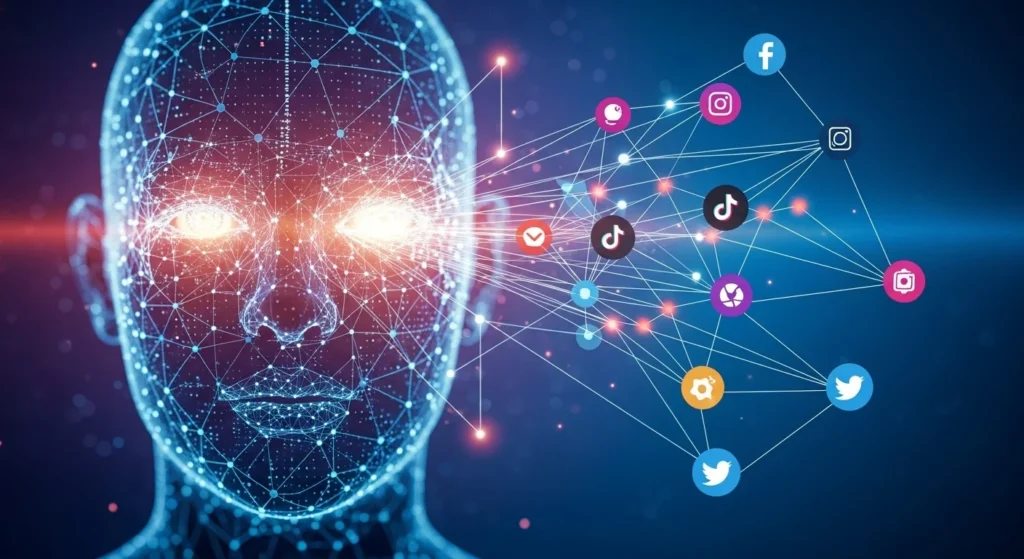
The Moment a Platform Knows It’s You
You upload a photo.
No name.
No tag.
No caption.
Yet the platform quietly suggests who’s in it — often correctly.
It feels convenient.
Almost magical.
But behind that suggestion is one of the most powerful identity technologies ever deployed at scale: facial recognition.
On social platforms, facial recognition doesn’t just recognize faces.
It connects identity, behavior, relationships, and history — all from an image.
What Facial Recognition Really Means in Social Media
Facial recognition is often misunderstood as simple image matching.
In reality, it’s a multi-stage identity system that:
- Detects a face in an image
- Measures unique facial features
- Converts them into mathematical representations
- Compares them against stored face templates
On social platforms, this process happens automatically, silently, and at massive scale.
The result isn’t just recognition.
It’s association.
Step-by-Step: How Facial Recognition Works on Social Platforms
1. Face Detection Comes First
Before recognition, systems must detect a face.
AI models scan images for patterns resembling:
- Eyes
- Nose
- Mouth
- Facial contours
This works even in:
- Group photos
- Low-quality images
- Side angles
Detection answers one question:
“Is there a human face here?”
2. Feature Mapping Turns Faces Into Data
Once detected, the system analyzes facial landmarks such as:
- Distance between eyes
- Shape of cheekbones
- Jawline structure
- Relative position of nose and mouth
These measurements are converted into a numerical vector — often called a faceprint.
This faceprint is not a photo.
It’s data.
3. Matching Faces Across Images
The platform compares this faceprint against others in its database.
If similarity crosses a confidence threshold, the system suggests a match.
This is how platforms can recognize you:
- Across years
- Across lighting conditions
- Across hairstyles
- Across aging
The faceprint evolves as more data is collected.
Why Social Platforms Are Uniquely Powerful at This
Unlike standalone facial recognition systems, social platforms have advantages:
- Massive photo libraries
- Self-labeled data (tags, profiles)
- Social context (friends, locations)
- Continuous updates
Platforms like Meta and Google didn’t just build facial recognition.
They trained it using billions of real-world images.
That scale matters.
Facial Recognition Is About Probability, Not Certainty
Contrary to popular belief, facial recognition doesn’t “know” who you are.
It calculates likelihood.
A match suggestion means:
“This face is statistically similar to faces associated with this identity.”
Accuracy improves with:
- More images
- Consistent tagging
- Clear visibility
- Stable identity patterns
Which is why active users are easier to recognize.
What Data Is Actually Stored (And What Isn’t)
A common concern is that platforms store your actual face image.
In most systems:
- The faceprint is stored, not the photo
- Photos remain separate
- Faceprints are derived data
However, faceprints are still biometric identifiers.
They uniquely represent you — and cannot be changed like passwords.
How Facial Recognition Is Used Beyond Tagging
On social platforms, facial recognition supports:
- Photo tagging suggestions
- Duplicate account detection
- Account recovery
- Fake profile identification
- Content organization
In some cases, it also assists moderation and abuse prevention.
The same system enables convenience and control.
Why This Matters Today (And Going Forward)
Facial recognition is no longer experimental.
It’s infrastructure.
As platforms expand into:
- Digital identity
- Payments
- Access control
- Personalized experiences
Your face becomes a persistent identifier.
This shifts identity from something you know to something you are.
And that change is irreversible.
Facial Recognition vs Traditional Identification
| Traditional ID | Facial Recognition |
|---|---|
| Passwords | Biometric traits |
| Changeable | Permanent |
| User-controlled | System-derived |
| Explicit login | Passive recognition |
| Limited context | Cross-platform potential |
This difference explains why facial recognition raises deeper questions than older tech.
Common Misunderstandings About Facial Recognition
1. “It Only Works If I’m Tagged”
Even untagged photos can be used to improve recognition accuracy.
2. “Deleting Photos Deletes My Face Data”
Faceprints may persist even after photo removal, depending on platform policy.
3. “It’s Only Used for Convenience”
The same data can support security, moderation, and analytics.
Intent matters less than capability.
Real-Life Examples Users Often Miss
Example 1: Auto-Tagging Improvements
If tagging accuracy improves over time, it’s because the system learns from confirmation and correction.
Every interaction trains the model.
Example 2: Recognition Across Events
Being recognized across weddings, offices, vacations, and family gatherings isn’t coincidence.
It’s identity continuity.
Mistakes Users Make With Facial Recognition
- Assuming opt-out means non-collection
- Ignoring default settings
- Underestimating passive data capture
- Treating face data like regular metadata
Biometric data behaves differently.
It compounds.
Actionable Steps Users Can Take
1. Review Facial Recognition Settings
Most platforms offer controls — but they’re often buried.
2. Limit Tagging Permissions
Manual approval adds friction to data training.
3. Be Selective About Public Photos
Public images expand recognition surface.
4. Understand Platform Policies
Terms matter more than UI labels.
Hidden Insight: Facial Recognition Shapes Social Graphs
Faces don’t exist in isolation.
They connect people.
Recognition systems learn:
- Who appears together
- How often
- In what contexts
This strengthens relationship mapping — even without explicit interaction.
Your face becomes part of a network signal.
Key Takeaways
- Facial recognition converts faces into biometric data
- Social platforms use probability-based matching
- Tagging trains systems continuously
- Faceprints persist longer than photos
- Convenience and identity are tightly linked
- User awareness lags behind capability
Frequently Asked Questions
1. Is facial recognition always accurate?
No. Accuracy varies based on data quality, diversity, and system design.
2. Can facial recognition work without my consent?
Consent depends on platform policy and regional regulation.
3. Is face data more sensitive than other data?
Yes. It’s permanent and uniquely tied to identity.
4. Does turning it off stop all processing?
Not always. It may stop active features but not all background analysis.
5. Will facial recognition become unavoidable?
Its use is expanding, but user control and regulation continue to evolve.
Conclusion: Your Face Is Becoming a Digital Key
Facial recognition on social platforms isn’t just about tagging photos.
It’s about how identity is inferred, remembered, and reused.
As this technology becomes quieter and more accurate, the real challenge isn’t whether it works.
It’s whether people understand how deeply it’s woven into their digital lives.
Because once your face becomes data, access, identity, and privacy change permanently.
Disclaimer: This article is for general informational purposes and reflects common technology practices, not specific legal or platform-specific advice.

Natalia Lewandowska is a cybersecurity specialist who analyzes real-world cyber attacks, data breaches, and digital security failures. She explains complex threats in clear, practical language so everyday users can understand what really happened—and why it matters.