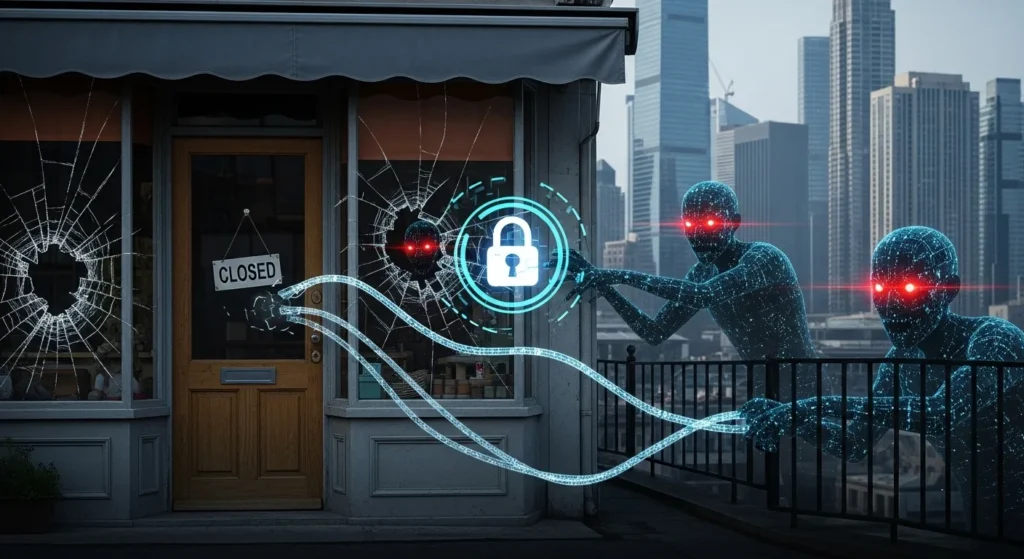
The Cyber Myth That Puts Small Businesses at Risk
Ask most small business owners if they’re worried about cyberattacks, and you’ll hear the same response.
“We’re too small.”
“We don’t have valuable data.”
“Hackers go after big companies.”
That belief feels comforting.
And it’s exactly why it’s dangerous.
In reality, small businesses are the easiest, fastest, and most profitable cyber targets.
Not because they’re careless.
But because attackers know something many owners don’t:
Small businesses sit at the perfect intersection of access, trust, and weak defenses.
And once compromised, recovery is far harder than most expect.
Why Hackers Prefer Small Businesses Over Big Corporations
Big corporations have:
- Dedicated security teams
- Continuous monitoring
- Incident response plans
- Legal and insurance buffers
Small businesses usually don’t.
From an attacker’s perspective, that means:
- Less resistance
- Faster access
- Lower chance of detection
- Higher success rates
Cybercrime is not about prestige.
It’s about efficiency.
And small businesses offer the best return for the least effort.
The Numbers Most Small Businesses Never See
Security research consistently shows that small and mid-sized businesses experience the majority of cyber incidents, not enterprises.
What’s more concerning isn’t just how often attacks happen—but what happens next.
After a serious cyber incident:
- Many small businesses face months of disruption
- Customer trust drops sharply
- Credit access tightens
- Insurance costs rise
- Some never fully recover
For a small operation, downtime isn’t an inconvenience—it’s a survival threat.
The Real Reason Small Businesses Are Easier to Breach
It’s not ignorance.
It’s structure.
Small businesses are built for speed, trust, and flexibility—not defense.
Common realities include:
- Shared logins
- Personal devices used for work
- Limited IT oversight
- Informal access controls
- Cloud tools added quickly without review
These aren’t mistakes.
They’re survival strategies.
Unfortunately, attackers exploit exactly these conditions.
Why “We Don’t Have Anything Worth Stealing” Is a Costly Assumption
Most breaches aren’t about stealing secrets.
They’re about:
- Email access
- Payment redirection
- Ransomware
- Customer data
- Credential reuse
Even a simple business email account can be used to:
- Send fake invoices
- Steal vendor payments
- Launch phishing attacks
- Access connected financial systems
That’s why incidents like the Target showed how even indirect access can trigger massive financial consequences—especially for partners and vendors downstream.
Small businesses are often the entry point, not the final target.
How Small Business Breaches Usually Start (It’s Rarely Dramatic)
Forget movie-style hacking.
Most small business breaches begin quietly:
- A phishing email
- A reused password
- A compromised vendor account
- An unsecured cloud folder
Often, no alarms go off.
Weeks or months later, damage surfaces:
- Missing funds
- Angry customers
- Locked systems
- Legal notices
By then, the attacker is long gone.
A Simple Comparison: Big Companies vs Small Businesses
| Factor | Big Corporations | Small Businesses |
|---|---|---|
| Security budget | High | Limited |
| Dedicated IT teams | Yes | Rare |
| Monitoring systems | Advanced | Minimal |
| Recovery resources | Strong | Constrained |
| Attack payoff | Slower | Faster |
Cybercriminals optimize for speed, not scale.
Why Ransomware Hits Small Businesses Especially Hard
Ransomware doesn’t care about revenue size.
It cares about pressure.
Small businesses:
- Can’t afford long shutdowns
- Often lack recent backups
- Depend on daily cash flow
- Have limited legal options
That’s why attackers know small businesses are more likely to pay—not because they’re reckless, but because they’re cornered.
Once systems are locked, choices shrink fast.
The Trust Problem: Customers Expect More Than You Realize
Customers don’t judge businesses by size when it comes to data protection.
They expect:
- Payment security
- Privacy protection
- Professional handling of data
When a breach occurs, the emotional reaction is the same:
- Loss of trust
- Fear of misuse
- Perception of negligence
Reputation damage hurts small businesses more deeply and for longer than large brands.
Why This Matters Today (And Won’t Fade Away)
Business is becoming:
- More digital
- More remote
- More cloud-based
That means:
- More access points
- More shared credentials
- More third-party tools
Cyber risk grows quietly alongside growth.
Ignoring it doesn’t keep things simple—it just makes recovery harder later.
Common Cyber Mistakes Small Businesses Make
These are understandable—but avoidable.
- Assuming antivirus is “enough”
- Trusting vendors without verification
- Delaying updates and patches
- Using personal email for business
- Not training staff at all
Most breaches exploit routine habits, not technical complexity.
Practical Steps That Actually Reduce Risk (Without Overkill)
Cybersecurity doesn’t need to be expensive or complex.
High-impact basics include:
- Unique passwords for critical systems
- Multi-factor authentication for email and finance tools
- Regular software updates
- Simple employee awareness training
- Offline or immutable backups
Small steps reduce risk dramatically.
Real-Life Scenario: A One-Click Mistake
A small accounting firm receives an email from a known client.
The tone feels right.
The timing makes sense.
One attachment is opened.
Within hours:
- Files are encrypted
- Client data is locked
- Operations stop
This pattern mirrors countless real incidents—including those following large breaches like Equifax, where stolen data fueled years of downstream attacks on smaller firms.
Attackers reuse what works.
Key Takeaways
- Small businesses are targeted because they’re efficient to breach
- Most attacks exploit routine behavior, not advanced hacking
- Recovery is harder for small businesses than large ones
- Cyber risk is a business continuity issue, not just IT
- Basic protections dramatically reduce exposure
Frequently Asked Questions (FAQ)
1. Are small businesses really targeted more than large companies?
Yes. Attackers focus on ease, speed, and success rates—not company size.
2. Is cybersecurity too expensive for small businesses?
Basic protections are affordable and far cheaper than recovery after a breach.
3. Do only online businesses need to worry?
No. Any business using email, payments, or cloud tools is exposed.
4. Can cyber insurance replace security measures?
Insurance helps with recovery, but prevention reduces damage and disruption.
5. What’s the first thing a small business should secure?
Email access. Most attacks start there.
Conclusion: Being Small Isn’t the Risk — Being Unprepared Is
Hackers don’t target small businesses because they’re weak.
They target them because they’re human, busy, and trusting.
The good news?
Cybersecurity doesn’t require becoming a tech company.
It requires awareness, basics, and consistency.
Small businesses that plan ahead don’t just survive attacks—they often avoid them entirely.
Disclaimer: This article is for general informational purposes only and does not replace personalized cybersecurity or business advice.

Natalia Lewandowska is a cybersecurity specialist who analyzes real-world cyber attacks, data breaches, and digital security failures. She explains complex threats in clear, practical language so everyday users can understand what really happened—and why it matters.