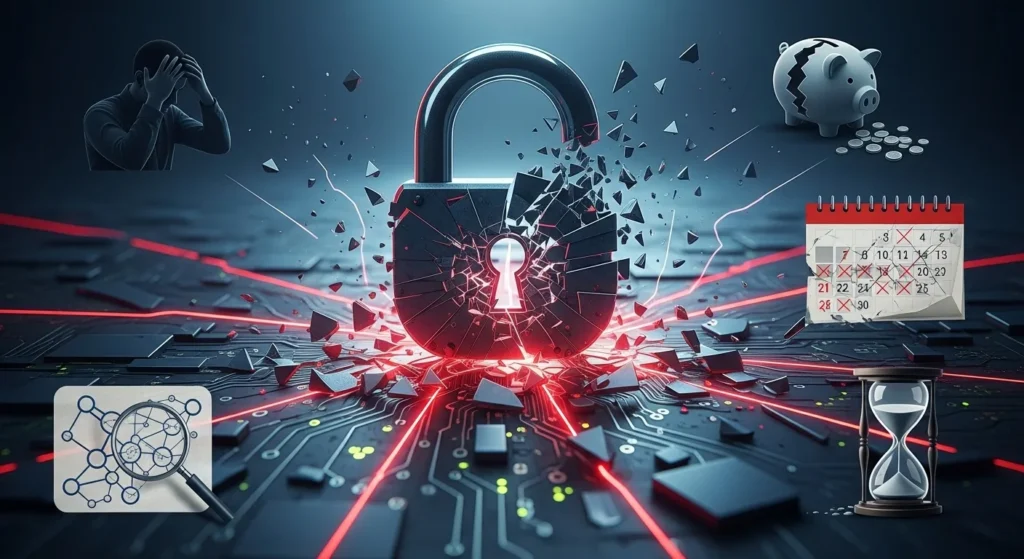
The Invoice You Never See Coming
Most people think they know what a cyber attack costs.
A ransom payment.
Some IT cleanup.
Maybe a short outage.
Then business goes back to normal.
That belief is dangerously incomplete.
In reality, the largest costs of a cyber attack never appear on an invoice. They surface slowly, quietly, and often months later—long after the headlines fade.
And by the time leadership sees the full picture, the damage is already baked into the business.
This is the real cost story most companies only understand after it’s too late.
The Immediate Costs Everyone Expects (And Underestimates)
The first wave of cyber attack costs is the most visible.
These are the expenses executives usually prepare for—and still underestimate.
They include:
- Incident response and forensic investigations
- System restoration and downtime
- Emergency IT consultants and legal advisors
- Ransom payments (when applicable)
For large organizations, these initial costs can reach millions within days.
But here’s the uncomfortable truth:
This is often the smallest part of the total damage.
Downtime: When Every Hour Has a Price Tag
When systems go down, business doesn’t slow—it stops.
Revenue pauses.
Orders freeze.
Customers wait.
Even a short outage can have cascading effects:
- Missed sales opportunities
- Contract penalties
- Supply chain disruptions
- Employee productivity loss
For digital-first businesses, downtime can cost tens or hundreds of thousands per hour.
For global firms, it can cost far more.
Downtime isn’t just lost time—it’s lost momentum.
The Hidden Cost of Lost Trust
Trust is one of the most valuable—and fragile—business assets.
A cyber attack damages it instantly.
Customers begin to question:
- Is my data safe here?
- Can I trust this brand again?
- Should I move to a competitor?
Once trust erodes, it doesn’t recover on a timeline.
It recovers slowly, if at all.
Many companies see customer churn spike after breaches, even when services are restored quickly.
The systems recover faster than confidence does.
Real-World Examples That Changed the Conversation
Several high-profile incidents exposed how expensive cyber attacks truly are.
- Equifax faced billions in total costs, including settlements, remediation, and long-term brand damage.
- At Maersk, a cyberattack shut down operations worldwide, costing hundreds of millions in lost business.
- Target saw profits drop sharply following its breach, driven by customer backlash and remediation expenses.
In each case, recovery costs far exceeded initial estimates.
Regulatory and Legal Costs Add Up Quietly
Modern data protection laws changed the financial equation.
After a breach, companies may face:
- Regulatory fines
- Mandatory audits
- Legal settlements
- Class-action lawsuits
Even when fines are manageable, legal defense and compliance costs accumulate over years.
These expenses rarely make headlines—but they drain resources steadily.
Cyber attacks don’t just trigger a crisis.
They trigger long-term legal exposure.
Employee Impact: The Cost No Spreadsheet Shows
Cyber incidents don’t just affect systems.
They affect people.
Employees experience:
- Increased workload and stress
- Disrupted workflows
- Morale decline
- Loss of confidence in leadership
High-performing teams burn out faster after major incidents.
Some key employees leave—not because of the breach, but because of how it was handled.
Replacing talent is expensive, slow, and disruptive.
Insurance Helps—But It Doesn’t Make You Whole
Cyber insurance can offset some direct costs.
But it has limits.
Insurance often doesn’t cover:
- Reputational damage
- Customer churn
- Lost competitive advantage
- Long-term revenue decline
Insurance is recovery support, not a business reset.
Companies that rely on it as a safety net often discover the gaps too late.
Comparison Table: Visible vs Invisible Cyber Attack Costs
| Cost Type | Visible Costs | Invisible Costs |
|---|---|---|
| Financial | Ransom, IT recovery | Lost customers, lower sales |
| Operational | Downtime | Productivity decline |
| Legal | Fines, settlements | Ongoing compliance burden |
| Reputational | Media coverage | Long-term trust erosion |
| Human | Overtime pay | Burnout, attrition |
The most damaging costs are rarely the easiest to measure.
Why Cyber Attacks Cost More Than Expected
Most organizations underestimate costs because they focus on event recovery, not business recovery.
Systems can be restored quickly.
Reputation, trust, and confidence cannot.
Additionally:
- Breaches expose existing inefficiencies
- Security upgrades become urgent and expensive
- Leadership time shifts from growth to crisis management
Opportunity cost becomes enormous.
What didn’t you build because you were busy repairing?
Why This Matters Today (And Going Forward)
Digital dependency keeps increasing.
More data.
More integrations.
More third-party exposure.
This means future cyber attacks won’t just be technical incidents.
They’ll be business-altering events.
Organizations that still view cyber risk as a narrow IT issue are budgeting for the wrong problem.
Common Mistakes That Increase Cyber Attack Costs
Many losses are amplified by avoidable errors:
- Delayed incident detection
- Poor internal communication
- No crisis response plan
- Lack of executive involvement
- Underinvestment in prevention
The breach itself may be unavoidable.
The scale of damage often isn’t.
Actionable Steps to Reduce the Real Cost of Cyber Attacks
You can’t eliminate risk—but you can contain damage.
Practical steps include:
- Invest in early detection and monitoring
- Practice executive-level incident response
- Map critical business dependencies
- Communicate transparently with stakeholders
- Treat cybersecurity as business continuity
Preparedness doesn’t stop attacks.
It limits how much they take from you.
Key Takeaways
- Cyber attacks cost far more than technical recovery
- Trust loss often exceeds financial loss
- Downtime and disruption compound quickly
- Insurance reduces pain, not damage
- Preparation determines the true cost
Understanding these costs changes how leaders invest.
Frequently Asked Questions
How much does a cyber attack typically cost a business?
Costs vary widely, but for many organizations, total impact reaches millions when downtime, trust loss, and legal exposure are included.
Are small businesses affected as severely as large ones?
Smaller businesses often feel the impact more acutely because they have fewer resources to absorb losses.
Does paying a ransom reduce overall costs?
Not necessarily. Paying may restore access, but it doesn’t erase reputational or regulatory consequences.
Can strong cybersecurity completely prevent attacks?
No. But it can significantly reduce damage and recovery time.
What’s the biggest hidden cost of a cyber attack?
Lost trust—because it affects future revenue long after systems are fixed.
Conclusion: The Real Cost Is What Lingers After Recovery
A cyber attack doesn’t end when systems come back online.
It lingers in customer behavior.
In employee confidence.
In leadership decisions.
The businesses that survive aren’t the ones that never get attacked.
They’re the ones that understand what attacks really cost—and prepare accordingly.
Disclaimer: This article is for general informational purposes only and reflects common business experiences, not guidance for any specific organization.

Natalia Lewandowska is a cybersecurity specialist who analyzes real-world cyber attacks, data breaches, and digital security failures. She explains complex threats in clear, practical language so everyday users can understand what really happened—and why it matters.