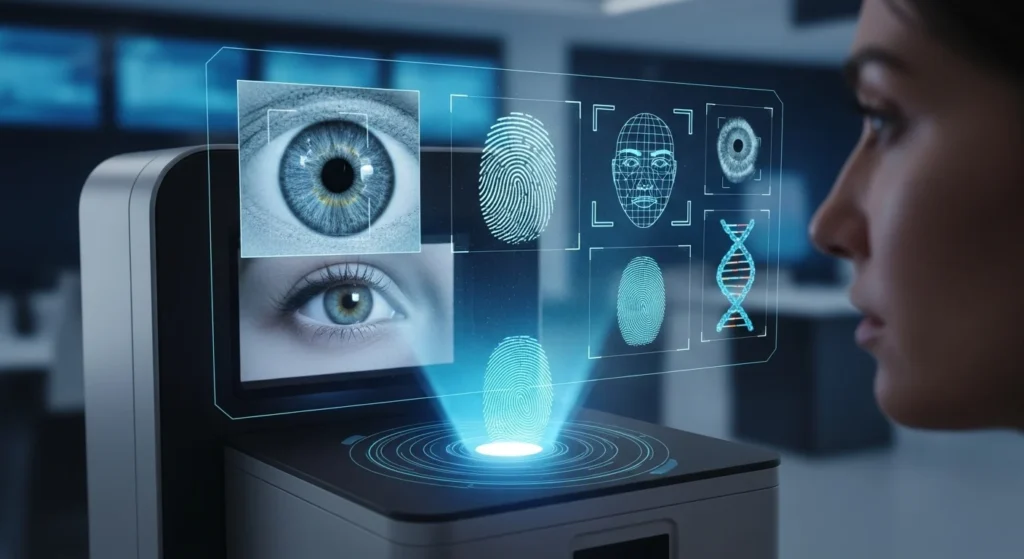
The Moment Privacy Became Physical
There was a time when privacy was protected by things you knew.
A password.
A PIN.
A secret answer.
Today, privacy is protected by who you are.
Your fingerprint unlocks your phone.
Your face opens your bank app.
Your voice verifies your identity on a customer service call.
Biometric security feels effortless, futuristic, and safer than ever.
But beneath that convenience lies a permanent shift—one that quietly changes privacy forever.
Because once your body becomes the key, you can’t reset it.
This article explores what biometric security really means for privacy, how it changes power dynamics, where the risks live, and how to protect yourself in a world where identity is no longer optional.
What Exactly Is Biometric Security?
Biometric security uses unique biological traits to identify and authenticate individuals.
Common biometric identifiers include:
- Fingerprints
- Facial structure
- Iris or retina patterns
- Voice patterns
- Hand geometry
- Behavioral traits (typing rhythm, walking gait)
Unlike passwords, biometrics are:
- Inherent (you carry them everywhere)
- Non-transferable (hard to share)
- Difficult to replicate (but not impossible)
This is why biometrics are now used in:
- Smartphones and laptops
- Airports and border control
- Banking and financial apps
- Healthcare systems
- Corporate security access
The promise is simple: stronger security with less effort.
The reality is more complex.
Why Biometric Security Feels Safer Than It Actually Is
Biometrics trigger a powerful emotional response.
Your brain instinctively trusts:
- Your face more than a password
- Your fingerprint more than a code
- Your voice more than a username
This creates perceived security, which often exceeds actual security.
Here’s why that matters.
Passwords can be changed.
Biometrics cannot.
If your password leaks, you reset it.
If your fingerprint data leaks, you live with that exposure forever.
That permanence fundamentally alters privacy risk.
The Biggest Privacy Shift: From Data You Control to Data You Are
Traditional privacy was about information you owned.
Biometric privacy is about information you embody.
This shift creates three irreversible changes:
1. Consent Becomes Blurry
You can choose not to share a password.
But can you choose not to show your face in public?
Facial recognition cameras don’t ask permission.
Voice recognition systems may activate passively.
Behavioral biometrics work silently in the background.
Privacy becomes passive instead of intentional.
2. Breaches Become Permanent
When biometric databases are compromised:
- You cannot issue a “new face”
- You cannot regenerate fingerprints
- You cannot erase voice patterns already copied
This makes biometric data high-value targets for attackers.
3. Surveillance Becomes Frictionless
Biometrics enable identification without interaction.
No login.
No prompt.
No awareness.
This allows:
- Continuous tracking
- Identity linking across systems
- Profiling without explicit consent
Privacy doesn’t disappear overnight—it erodes quietly.
Biometric Security vs Traditional Security: A Clear Comparison
| Feature | Traditional Security | Biometric Security |
|---|---|---|
| Changeable | Yes (password reset) | No (biological) |
| Can be shared | Yes | No |
| Risk after breach | Temporary | Permanent |
| User awareness | High | Often low |
| Convenience | Medium | Very high |
| Privacy impact | Moderate | Deep & lasting |
This table explains why biometrics feel advanced—but also why mistakes carry heavier consequences.
Real-Life Examples That Reveal the Risk
Example 1: Stolen Fingerprint Databases
Several large biometric databases worldwide have been breached, exposing millions of fingerprint records.
Those users didn’t just lose access.
They lost biometric exclusivity forever.
Example 2: Facial Recognition in Public Spaces
Airports, malls, and cities increasingly deploy facial recognition.
Even if data is anonymized, identity matching can happen later.
Privacy risk doesn’t end when data is collected—it begins.
Example 3: Voice Authentication Abuse
Recorded voice samples can now be cloned using AI tools.
That means voice-based security can be bypassed using leaked data.
Why This Matters Today (and Long Into the Future)
Biometric security is becoming the default, not the exception.
Once normalized:
- Opting out becomes difficult
- Alternatives disappear
- Resistance looks suspicious
The real risk isn’t misuse—it’s dependency.
When systems rely entirely on biometric identity:
- Errors become exclusion
- False matches become barriers
- Data misuse becomes life-altering
Privacy stops being a setting.
It becomes a condition.
Common Mistakes People Make With Biometric Security
1. Assuming Biometrics Are Always More Secure
Biometrics reduce some risks but introduce new ones.
They are identifiers, not secret keys.
2. Using Biometrics Without Backup Controls
Relying only on face or fingerprint authentication increases exposure.
Best practice is multi-factor authentication.
3. Ignoring Where Biometric Data Is Stored
Not all systems store data locally.
Cloud-stored biometric templates carry higher breach risk.
Hidden Tips to Protect Your Privacy in a Biometric World
Here are practical, actionable steps you can take today:
- Enable biometrics only on devices with secure hardware enclaves
- Combine biometrics with:
- PINs
- Passcodes
- Device-based authentication
- Avoid biometric authentication for:
- High-risk financial actions
- Account recovery processes
- Regularly review:
- App permissions
- Device security settings
- Disable biometric access on unused or older devices
Convenience should never be automatic.
The Ethical Question No One Talks About
Who owns biometric data?
Is it:
- You?
- The company collecting it?
- The government regulating it?
In practice, ownership is fragmented.
This creates:
- Legal gray zones
- Cross-border data exposure
- Long-term uncertainty
Privacy isn’t just technical anymore—it’s philosophical.
The Future of Privacy in a Biometric World
Biometric security isn’t going away.
But privacy-aware systems are emerging:
- On-device biometric processing
- Encrypted biometric templates
- Zero-knowledge authentication models
- User-controlled identity frameworks
The future depends on design choices made today.
Privacy isn’t lost.
But it must be defended intentionally.
Key Takeaways
- Biometric security permanently changes privacy dynamics
- Your body is now a form of data—and data can leak
- Convenience often hides long-term risk
- Biometric breaches are irreversible
- Smart use combines biometrics with traditional safeguards
- Awareness is the strongest form of protection
Frequently Asked Questions (FAQ)
1. Is biometric security safer than passwords?
It’s safer against guessing and theft, but riskier if data is compromised because biometrics can’t be changed.
2. Can biometric data be hacked?
Yes. While difficult, biometric databases can be breached, and biometric traits can be replicated using advanced tools.
3. Should I stop using biometric authentication?
Not necessarily. Use it wisely, with additional security layers and only on trusted devices.
4. Is facial recognition the biggest privacy risk?
Facial recognition carries unique risks because it can be used passively and at scale without user interaction.
5. Who regulates biometric privacy?
Regulation varies by country, and enforcement often lags behind technological adoption.
Conclusion: Privacy Isn’t Dead—But It’s Different Now
Biometric security didn’t kill privacy.
It transformed it.
Your identity is no longer something you type.
It’s something you are.
That makes protection more personal—and more important than ever.
The future belongs to those who understand this shift early and choose convenience without surrendering control.
Disclaimer: This article is for general informational purposes only and does not constitute legal or cybersecurity advice.

Natalia Lewandowska is a cybersecurity specialist who analyzes real-world cyber attacks, data breaches, and digital security failures. She explains complex threats in clear, practical language so everyday users can understand what really happened—and why it matters.
Pingback: Why Your Face Is Becoming a Password (And What That Means for Your Privacy)