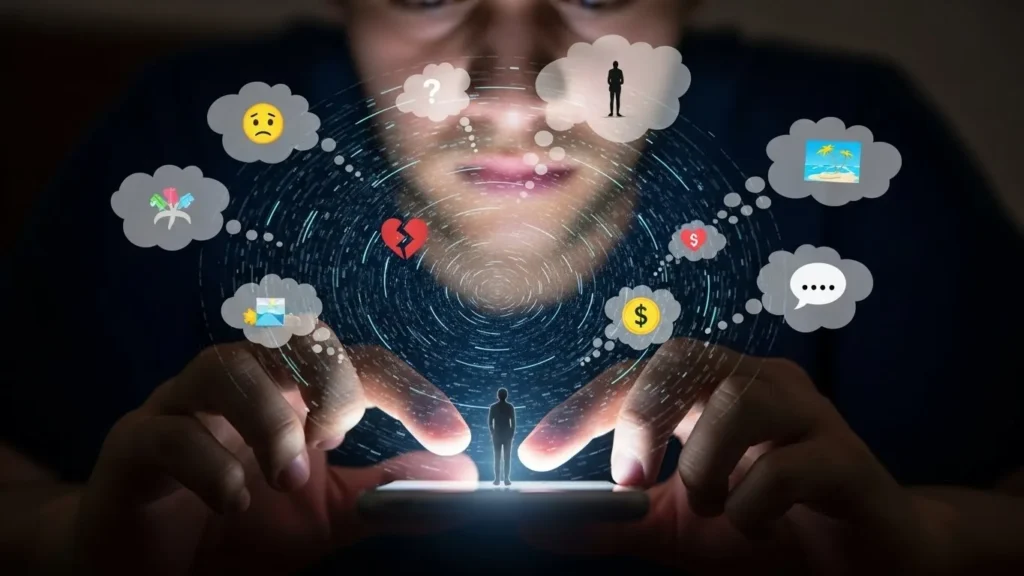
The Thoughts You Never Typed—but Still Revealed
You may never post about your fears.
You may never like content that feels “too personal.”
You may never comment on what truly moves you.
Yet somehow, your feed reflects it perfectly.
That’s because your likes and scrolls act like digital body language.
They reveal patterns of interest, hesitation, curiosity, and emotion—often more honestly than words.
Here’s the uncomfortable truth:
You don’t need to speak for your private thoughts to be noticed. Your behavior already speaks.
In this article, we’ll explore how everyday actions—liking, scrolling, pausing, skipping—quietly expose what’s going on in your mind, and why this matters far more than most people realize.
Likes Are Not Opinions—They’re Signals
Most people treat likes casually.
A quick tap.
A harmless reaction.
Nothing serious.
But in data psychology, a like isn’t agreement—it’s confirmation of relevance.
When you like something, you signal:
- Emotional resonance
- Cognitive alignment
- Identity curiosity
- Aspirational interest
Even if you “liked it ironically,” systems don’t understand irony. They understand probability.
One like doesn’t define you.
Patterns of likes? That’s a profile.
Scrolling Is the Most Honest Behavior Online
If likes are deliberate, scrolling is instinctive.
You can fake a post.
You can censor a comment.
You cannot fake attention.
Scrolling reveals:
- What bores you instantly
- What makes you pause
- What you reread
- What you avoid completely
The length of your pause often matters more than whether you interact.
A three-second hover can be louder than a like.
The Science Behind Behavioral Interpretation
Modern platforms rely on behavioral psychology and data science, including:
- Attention tracking – measuring time spent per content unit
- Micro-interactions – taps, pauses, rewinds, skips
- Sequence analysis – what you view before and after certain content
- Emotional clustering – grouping content by emotional tone
When millions of users show similar behavior patterns, systems learn what those patterns mean.
That’s how behavior turns into insight.
Real-Life Example: The “No-Like” User
Consider someone who:
- Never likes emotional posts
- Rarely comments
- Scrolls quietly
Yet:
- Watches long-form content to the end
- Pauses longer on reflective posts
- Replays certain videos late at night
To others, they seem disengaged.
To algorithms, they appear:
- Emotionally selective
- Thoughtful
- Internally expressive
- Privacy-conscious
Their private thoughts aren’t hidden—they’re inferred.
What Your Scrolling Speed Says About You
Scrolling speed is one of the most revealing signals.
Fast scrolling often suggests:
- Overstimulation
- Low emotional engagement
- Information fatigue
Slow scrolling can indicate:
- Deep curiosity
- Emotional processing
- Higher cognitive involvement
Variable speed often reflects mood changes.
Your thumb movement becomes a mood map.
Comparison Table: What You Think vs What Platforms See
| Your Action | What You Think It Means | What Systems Interpret |
|---|---|---|
| Liking a post | Casual interest | Emotional alignment |
| Skipping content | Not relevant | Active disinterest |
| Pausing briefly | Just curious | Cognitive engagement |
| Rewatching | Missed something | Strong resonance |
| Late-night scrolling | Killing time | Emotional vulnerability |
This gap between intention and interpretation is where insights emerge.
Why Silence Is Not Privacy
Many users believe:
“If I don’t like or comment, I’m invisible.”
That’s a myth.
Silence is still behavior.
In fact, non-engagement is often more informative than engagement because it’s harder to fake.
Avoided topics reveal boundaries.
Repeated exposure reveals curiosity.
Delayed exits reveal inner conflict.
Your feed adapts accordingly.
Hidden Tip: The Power of Repeated Exposure
One of the strongest signals isn’t what you like—it’s what you keep seeing without rejecting.
If you repeatedly:
- Watch similar themes
- Tolerate certain ideas
- Don’t hide or block content
Systems infer openness—even if you never engage.
This is how beliefs are gently shaped over time.
Why This Matters Today (and Going Forward)
Understanding how likes and scrolls reveal thoughts matters because:
- It influences what information reaches you
- It shapes your worldview quietly
- It affects emotional states
- It impacts purchasing and belief formation
Personalization feels convenient—but it’s also directional.
Awareness gives you choice.
Common Mistakes Users Make
❌ Assuming intent matters more than behavior
❌ Believing only likes are tracked
❌ Ignoring watch time and pauses
❌ Thinking “everyone sees the same feed”
❌ Confusing personalization with neutrality
These assumptions reduce digital self-awareness.
Actionable Steps to Regain Control
You don’t need to panic or disconnect.
Instead:
- Be mindful of emotional scrolling
- Take breaks when content feels repetitive
- Diversify what you consume intentionally
- Use “not interested” options occasionally
- Reflect on why something keeps appearing
Small actions recalibrate patterns.
Do Likes and Scrolls Reveal Everything?
No.
They reveal tendencies, not truths.
They show patterns, not purpose.
They suggest probabilities, not destiny.
But probabilities, repeated enough, become powerful predictors.
And predictors shape experiences.
Key Takeaways
- Likes signal emotional and cognitive relevance
- Scrolling behavior is more honest than posting
- Pauses and watch time reveal private interests
- Silence still generates insight
- Awareness is the key to autonomy
Frequently Asked Questions (FAQ)
1. Can platforms really infer thoughts from scrolling?
They infer tendencies and interests, not exact thoughts—but accuracy improves with patterns.
2. Is this the same as mind-reading?
No. It’s behavioral prediction based on observable actions.
3. Do likes matter more than watch time?
Watch time and pauses are often stronger indicators than likes.
4. Can I reduce what my behavior reveals?
You can reduce accuracy through conscious, varied usage—but not eliminate it entirely.
5. Is personalization always harmful?
Not inherently. It becomes harmful when it goes unnoticed or unquestioned.
Conclusion: Your Behavior Is a Language—Learn to Read It
You don’t need to speak to be understood online.
Your likes whisper.
Your scrolls speak.
Your pauses explain.
Once you understand that your behavior is a language, you stop being a passive participant—and start becoming an aware one.
And awareness, in the digital world, is real power.
Disclaimer: This article is for general informational purposes and reflects common patterns in digital behavior and technology use.

Natalia Lewandowska is a cybersecurity specialist who analyzes real-world cyber attacks, data breaches, and digital security failures. She explains complex threats in clear, practical language so everyday users can understand what really happened—and why it matters.
Pingback: Why Social Media Knows Your Personality Better Than Your Friends (And What It Means for You)
Pingback: How Social Media Predicts Your Behavior Before You Act — The Invisible System Shaping Your Choices