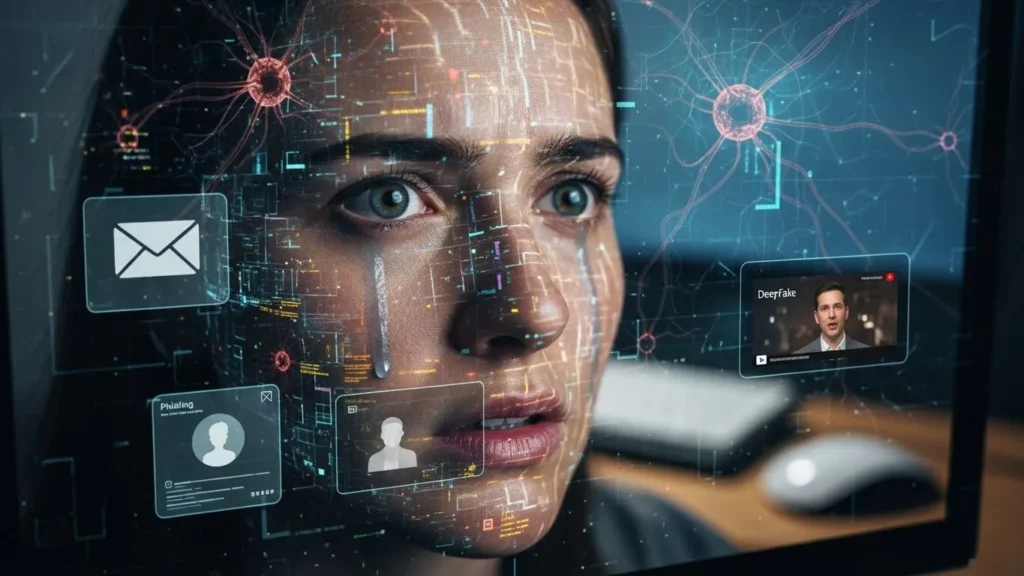
Why This Feels Different Than Old Scams
A few years ago, scams were easy to spot.
Bad grammar.
Generic greetings.
Suspicious links.
Today, many scams sound calm, personal, and convincing.
They reference real details.
They respond intelligently.
They adjust based on your reactions.
That shift didn’t happen by accident.
AI has quietly rewritten the rules of deception — and it’s why even cautious, educated people are falling for scams they never would have clicked on before.
This article explains why AI-driven scams are so hard to detect, what makes them psychologically powerful, and how to protect yourself in a world where fraud now sounds human.
The Old Scam Model vs the AI Scam Model
Traditional scams relied on volume.
Send a million emails.
Hope a few people fall for it.
AI scams rely on precision.
They adapt in real time.
They personalize messages.
They learn from you as the conversation unfolds.
This shift has made detection far more difficult — not just for individuals, but for banks, platforms, and security systems too.
How AI Mimics Human Communication So Well
Modern AI doesn’t just copy language.
It replicates human patterns.
It understands:
- Tone and emotion
- Conversational timing
- Politeness and urgency balance
- Contextual memory
That’s why an AI scammer doesn’t rush you immediately.
It may:
- Start with small talk
- Build familiarity
- Slowly introduce a “problem”
- Offer a solution that benefits you
This mirrors how real humans build trust — which is why your instincts don’t trigger alarms.
Why Your Brain Doesn’t Flag AI Scams as Dangerous
Human intuition evolved to detect obvious threats, not subtle imitation.
AI scams exploit this gap.
They avoid:
- Pressure-heavy language
- Spelling mistakes
- Aggressive demands
Instead, they use:
- Reassuring phrasing
- Logical explanations
- Empathy and patience
Your brain reads this as safe, even when it isn’t.
The Role of Personal Data in AI-Driven Scams
AI scams feel personal because they often are.
Public data fuels them:
- Social media posts
- Online reviews
- Data breaches
- Public profiles
With this, scammers can:
- Reference your workplace
- Mention family members
- Use correct locations and timelines
Nothing feels random — and that’s exactly the trap.
Deepfakes Changed the Game Completely
One of the most dangerous developments is AI-generated voice and video.
People have received:
- Calls from a “boss” requesting urgent transfers
- Voice messages from a “family member” in distress
- Video calls that look real at first glance
These scams exploit trust in familiar voices.
Authorities like the Federal Trade Commission have warned that deepfake-enabled fraud is growing rapidly because it bypasses traditional verification instincts.
Why Traditional Scam Detection Tools Fail
Most scam filters were designed for patterns.
AI scams break patterns constantly.
They:
- Change wording every time
- Avoid repeated templates
- Adapt based on user responses
This makes automated detection far harder.
Even advanced systems struggle because the scam doesn’t look like a scam — it looks like a conversation.
Emotional Timing: The Invisible Weapon
AI scams don’t just know what to say.
They know when to say it.
They often strike:
- When you’re busy
- When you’re stressed
- When quick decisions feel normal
Examples include:
- End-of-day “urgent” requests
- Travel-related messages
- Financial deadlines
The timing lowers your defenses more than the message itself.
Real-Life Example: A Scam That Fooled a Team
In a widely reported case, a finance employee transferred a large sum after a video call with what appeared to be senior executives.
Every face looked right.
Every voice matched.
The request sounded reasonable.
It was entirely AI-generated.
No malware.
No suspicious links.
Just trust — weaponized.
Common Mistakes People Make With AI Scams
Even cautious users fall into predictable traps.
Mistakes to avoid:
- Assuming calm tone equals legitimacy
- Trusting familiar voices without verification
- Relying on “gut feeling” alone
- Acting quickly to be helpful
AI scams exploit kindness and responsibility — not ignorance.
How AI Scams Compare to Traditional Scams
| Feature | Traditional Scams | AI-Driven Scams |
|---|---|---|
| Language quality | Poor or generic | Natural and fluent |
| Personalization | Minimal | Highly personalized |
| Emotional manipulation | Obvious pressure | Subtle, empathetic |
| Detection difficulty | Easier | Much harder |
| Adaptability | Fixed scripts | Real-time adjustment |
Subtle Signs AI Scams Still Can’t Fully Hide
Despite their sophistication, AI scams still have cracks.
Look for:
- Reluctance to verify through alternate channels
- Avoidance of video follow-ups after initial contact
- Overly perfect responses with no hesitation
- Requests to bypass standard procedures
The danger isn’t obvious errors — it’s procedural shortcuts.
Practical Steps That Actually Help
Forget vague advice like “be careful online.”
Here’s what works:
- Slow down responses
Scams thrive on speed. - Verify outside the conversation
Call known numbers. Use separate channels. - Normalize saying no
Legitimate organizations respect verification. - Limit public oversharing
Every detail fuels personalization. - Educate family and teams
Especially children and older adults.
Why This Matters More Than Ever
AI scams are no longer fringe cybercrime.
They’re:
- Scalable
- Convincing
- Emotionally intelligent
As AI tools become cheaper and more accessible, scams will continue to evolve faster than public awareness.
The goal isn’t fear.
It’s adaptation.
Key Takeaways
- AI-driven scams feel human because they mirror human communication patterns
- Personal data and timing make them emotionally convincing
- Deepfakes bypass instinctive trust checks
- Traditional detection tools struggle with adaptive conversations
- Slowing down and verifying independently remain the strongest defenses
Frequently Asked Questions
Are AI scams only online?
No. They occur via phone calls, voice notes, video calls, emails, and even text messages.
Can AI scams fool professionals?
Yes. Executives, finance teams, and cybersecurity experts have all been targeted successfully.
Are deepfake scams common yet?
They’re increasing rapidly and are expected to become far more common as AI tools spread.
Do scam filters protect against AI scams?
They help, but they’re not foolproof. Human verification still matters.
Is avoiding AI scams about being tech-savvy?
Not entirely. Awareness, patience, and verification matter more than technical knowledge.
A Simple Conclusion
AI didn’t just make scams smarter.
It made them more human.
That’s why detection feels harder — and why awareness, not panic, is the real defense.
When something sounds real, calm, and familiar, that’s exactly when it deserves a second look.
Disclaimer: This article is for general informational and educational purposes only and does not replace professional cybersecurity or financial advice.

Natalia Lewandowska is a cybersecurity specialist who analyzes real-world cyber attacks, data breaches, and digital security failures. She explains complex threats in clear, practical language so everyday users can understand what really happened—and why it matters.
Pingback: How AI Mimics Human Communication — The Subtle Signals That Make Machines Sound Real