The Quiet Frustration We’ve All Normalized
You forget a password.
You reset it.
You create a new one.
You forget that too.
At some point, frustration turns into resignation.
We’ve accepted passwords as a necessary annoyance — even though they were never designed for the digital lives we now live.
That’s why identity is replacing passwords.
Not as a dramatic revolution — but as a quiet correction to a system that no longer fits how humans behave online.
This article explains why passwords are fading, how identity-based security works, and why this shift is already underway across the digital world.
Passwords Were Built for a Simpler Internet
Passwords made sense when:
- Accounts were few
- Systems were isolated
- Users were technically trained
That world is gone.
Today, the average person manages dozens — sometimes hundreds — of digital accounts.
Passwords weren’t designed for:
- Constant reuse
- Phishing at scale
- Automated guessing
- Human memory limits
The problem isn’t user behavior.
The problem is that passwords ask humans to act like machines.
Why Passwords Fail Even When They’re “Strong”
Security advice often blames users:
“Make it longer.”
“Make it complex.”
“Never reuse it.”
But complexity doesn’t fix the core flaw.
Passwords can be:
- Stolen
- Shared
- Phished
- Replayed
A strong password is still a static secret.
Once exposed, it offers no context, no behavior, no verification beyond text matching.
That’s why breaches keep happening even in well-protected systems.
Identity Is Not a Single Thing — It’s a Pattern
When security shifts from passwords to identity, it stops asking:
“What do you know?”
And starts asking:
“Does this look like you?”
Identity-based systems evaluate:
- Device familiarity
- Location consistency
- Behavioral patterns
- Biometric signals
- Interaction timing
No single signal decides.
The combination does.
This makes identity harder to steal than a string of characters.
Why Identity-Based Security Scales Better Than Passwords
Passwords scale poorly because:
- Each new account adds cognitive load
- Each reset interrupts users
- Each compromise spreads risk
Identity scales naturally.
Once systems recognize you:
- Logging in becomes seamless
- Security improves without friction
- Risk adapts dynamically
This is why identity-based authentication feels invisible when it works — and why it’s replacing passwords quietly rather than loudly.
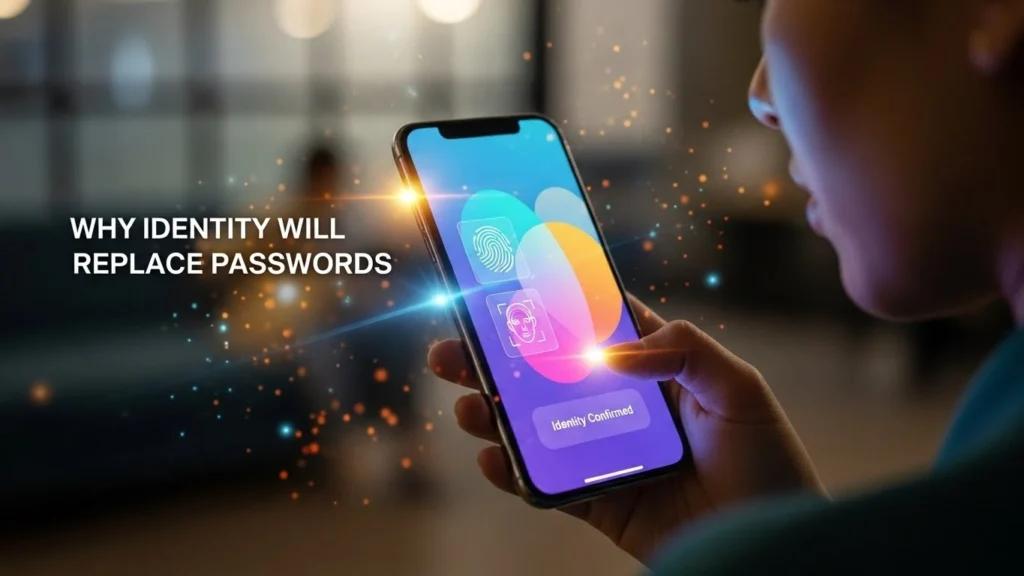
Real-Life Example: Your Phone Already Knows This
Think about how you unlock your smartphone.
You don’t:
- Type a password every time
- Prove yourself from scratch
Instead, your phone checks:
- Your face or fingerprint
- Your device
- Your usage context
This is identity-based security in action.
The success of mobile authentication accelerated passwordless thinking across the tech industry.
Biometrics Aren’t the Whole Story
Many people assume identity = biometrics.
That’s only part of it.
Identity systems also use:
- Behavioral biometrics (how you type, swipe, or move)
- Environmental context
- Historical usage patterns
Biometrics answer who you are.
Behavior answers whether it’s really you right now.
Together, they create layered trust — far stronger than passwords alone.
Why Phishing Breaks Passwords But Struggles With Identity
Phishing attacks succeed because passwords are transferable.
You can give them away — accidentally or intentionally.
Identity can’t be copied as easily.
Even if attackers get:
- A login link
- Partial credentials
- Some personal data
They often fail because:
- Device doesn’t match
- Behavior doesn’t align
- Context feels wrong
That’s why security bodies like the National Institute of Standards and Technology now recommend moving beyond password-only authentication models.
The Rise of Zero Trust Makes Passwords Obsolete
Modern security is shifting toward Zero Trust.
Zero Trust assumes:
- No user is trusted by default
- Every access is continuously evaluated
Passwords fit poorly into this model.
They offer:
- One-time verification
- No ongoing assurance
Identity-based security fits perfectly.
Trust becomes dynamic, not permanent.
Passwords vs Identity-Based Security
| Aspect | Passwords | Identity-Based Security |
|---|---|---|
| Nature | Static secret | Dynamic pattern |
| User effort | High | Low |
| Phishing resistance | Weak | Strong |
| Scalability | Poor | Excellent |
| Context awareness | None | Continuous |
This comparison explains why passwords are being phased out — not patched.
Why Identity Feels Less Secure (But Isn’t)
Some users feel uneasy about identity-based systems.
Common concerns include:
- “It’s watching me”
- “What if it gets it wrong?”
- “What if my biometrics are stolen?”
These concerns are understandable — but often misplaced.
Identity systems:
- Store signals, not raw behavior
- Use probabilistic checks, not absolute judgments
- Layer verification rather than relying on one factor
In practice, they reduce risk rather than increase it.
Common Mistakes People Make About Passwordless Security
Many assume:
- Passwordless means no security
- Biometrics replace all safeguards
- Identity systems are centralized and fragile
In reality:
- Identity systems are layered
- Passwordless doesn’t mean trustless
- Recovery options still exist
The goal isn’t removal of protection — it’s removal of friction.
Hidden Tip: Identity Reduces Human Error
Most breaches don’t happen because systems fail.
They happen because humans are tricked, rushed, or overwhelmed.
Identity-based security reduces:
- Decision fatigue
- Reset mistakes
- Reuse habits
When users don’t need to remember secrets, they make fewer errors — and security improves naturally.
Why This Matters Today
Digital identity is expanding rapidly.
We now use online systems for:
- Finance
- Healthcare portals
- Government services
- Work access
- Personal communication
Passwords were never designed for this level of dependence.
Identity-based security aligns better with how much is at stake — and how humans actually behave.
What the Transition Will Look Like (Not Overnight)
Passwords won’t vanish tomorrow.
They’ll fade.
The transition usually follows this path:
- Password + second factor
- Passwordless options introduced
- Identity-based defaults
- Passwords retained only as backup
This gradual shift keeps systems usable while security improves.
What Users Can Do to Prepare
You don’t need to wait.
Practical steps include:
- Enable passwordless options where available
- Use device-based authentication
- Reduce password reuse immediately
- Treat passwords as temporary, not permanent
- Learn recovery options before you need them
Preparation removes anxiety from change.
Key Takeaways
- Passwords fail because they’re static and transferable
- Identity-based security relies on patterns, not secrets
- Context, behavior, and devices create stronger trust
- Phishing loses power in identity-driven systems
- The shift is gradual, practical, and already happening
Frequently Asked Questions
Does identity-based security eliminate passwords entirely?
Not immediately. Passwords often remain as fallback options during transition.
Are biometrics safe to use?
Yes, when implemented correctly and combined with other signals.
What happens if identity systems make a mistake?
Most systems fall back to secondary verification rather than locking users out.
Is identity-based security only for large companies?
No. It’s increasingly common in consumer devices and everyday apps.
Will this reduce cybercrime?
It significantly reduces common attacks like phishing and credential theft.
A Simple Conclusion
Passwords aren’t disappearing because technology advanced.
They’re disappearing because humans didn’t change — and passwords demanded that we do.
Identity-based security works with human behavior instead of against it. It verifies presence, patterns, and context rather than relying on fragile secrets.
The future of security won’t ask you to remember more.
It will recognize you — quietly, continuously, and far more safely than passwords ever could.
Disclaimer: This article is for general informational purposes only and is not intended as technical or security implementation advice.

Natalia Lewandowska is a cybersecurity specialist who analyzes real-world cyber attacks, data breaches, and digital security failures. She explains complex threats in clear, practical language so everyday users can understand what really happened—and why it matters.
Pingback: How Biometric Security Changes Privacy Forever: What Your Body Now Reveals
Pingback: Why Your Face Is Becoming a Password (And What That Means for Your Privacy)
Pingback: How Digital Identity Is Replacing Physical Proof (And What That Means for Everyday Life)
Pingback: How Digital Identity Shapes Future Access — Who Gets In, Who Gets Blocked, and Why It Matters