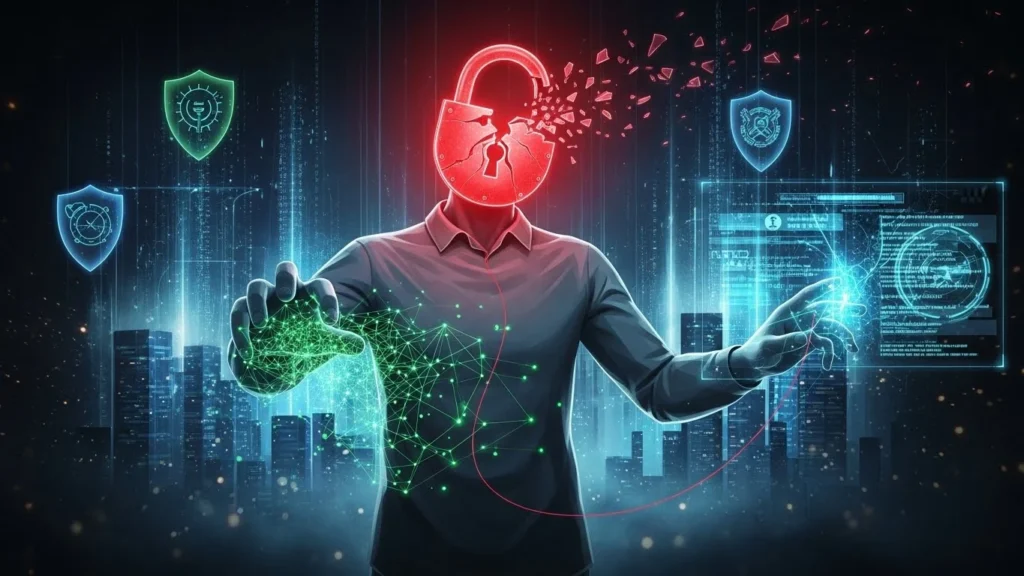
A Simple Question That Changes How You See Security
If security technology keeps getting smarter,
why do breaches keep happening?
Organizations invest millions in firewalls, encryption, AI detection, and zero-trust frameworks.
Yet headlines repeat the same story:
- A phishing email was clicked
- A password was reused
- Sensitive data was sent to the wrong person
The uncomfortable reality is this:
Most security failures don’t start with broken systems — they start with human decisions.
Not because people are careless.
But because security is built around humans… and humans are imperfect by design.
This article explains why human error is the weakest link in security, how attackers exploit it, and—most importantly—what actually works to reduce it.
The Surprising Scale of Human Error in Security Breaches
According to multiple global breach investigations, over 70–80% of security incidents involve a human element at some stage.
That includes:
- Clicking malicious links
- Falling for social engineering
- Using weak or reused passwords
- Misconfiguring cloud storage
- Sending data to the wrong recipient
Technology rarely “fails” on its own.
It’s usually used incorrectly, trusted too easily, or bypassed for convenience.
This is not a people problem.
It’s a design problem.
Why Humans Are Naturally Vulnerable — And Always Will Be
Security systems expect consistency.
Humans operate on emotion, habit, and context.
That mismatch is where risk is born.
Humans Are Wired to:
- Trust authority
- Respond quickly to urgency
- Help when asked
- Avoid friction
- Take shortcuts under pressure
Attackers don’t fight technology anymore.
They manipulate psychology instead.
That’s why social engineering works so well.
Social Engineering: Hacking the Human, Not the System
A phishing email doesn’t need advanced code.
It needs the right timing and tone.
Common tactics include:
- “Urgent: Account will be locked”
- “CEO needs this done now”
- “Invoice attached — please review”
- “Security alert: unusual login detected”
The message doesn’t look dangerous.
It looks familiar.
And familiarity disarms caution.
Real-Life Example: One Click, Massive Consequences
An employee receives what appears to be a routine document-sharing email.
They:
- Click the link
- Enter login credentials
- Continue their day
Nothing feels wrong.
Behind the scenes:
- Credentials are captured
- Attackers access internal systems
- Lateral movement begins
- Data is exfiltrated quietly
No firewall was breached.
No software was broken.
A human moment was exploited.
The Convenience vs Security Trade-Off Nobody Escapes
Security often fails where convenience wins.
People reuse passwords because:
- They have too many accounts
- Password rules are complex
- Managers feel like extra work
They bypass controls because:
- “It slows me down”
- “I’ve done this before”
- “Nothing bad happened last time”
From a human perspective, this is rational behavior.
From a security perspective, it’s catastrophic.
Why Training Alone Doesn’t Solve Human Error
Many organizations respond with:
- Annual security training
- Long policy documents
- Fear-based warnings
The result?
Minimal behavior change.
Why?
Because knowledge does not equal behavior.
People don’t make mistakes because they don’t know better.
They make mistakes because systems don’t align with how humans actually operate.
Technology vs Humans: A Comparison That Explains Everything
| Factor | Technology | Humans |
|---|---|---|
| Consistency | High | Low |
| Emotional influence | None | High |
| Fatigue | No | Yes |
| Susceptible to urgency | No | Yes |
| Learns from mistakes | Predictable | Inconsistent |
| Can be socially manipulated | No | Easily |
Security strategies fail when they assume humans will behave like machines.
They won’t.
Why Blaming Employees Makes Security Worse
When people fear punishment:
- Mistakes go unreported
- Incidents are hidden
- Learning opportunities disappear
The most secure organizations don’t punish human error.
They design systems that expect it.
Psychological safety is a security control—just not a technical one.
Hidden Mistake Most Companies Make (And Don’t Notice)
They protect systems, not decisions.
Security tools focus on:
- Blocking threats
- Detecting anomalies
- Logging events
But they ignore:
- Cognitive overload
- Decision fatigue
- Context switching
- Stress-driven behavior
A tired employee at 6:45 PM is not the same decision-maker as one at 10:00 AM.
Security rarely accounts for that.
How Attackers Exploit Human Patterns (Not Weakness)
Attackers study behavior patterns:
- When employees are busiest
- Which roles have authority
- Who is likely to bypass process
- Where approval fatigue exists
They don’t need insider access.
They need predictable human behavior.
What Actually Reduces Human Error (Without Expecting Perfection)
The goal is not to eliminate mistakes.
That’s impossible.
The goal is to make mistakes safe.
What Works in Practice:
- Default-secure systems (least privilege by design)
- Just-in-time access instead of permanent permissions
- Password managers that reduce cognitive load
- Clear, short decision prompts (“Is this expected?”)
- Easy reporting of mistakes without fear
Security improves when doing the right thing is easier than doing the wrong thing.
Actionable Steps Any Organization Can Take Today
1. Reduce Decisions, Don’t Add Rules
Every extra step increases error probability.
2. Design for Failure
Assume clicks will happen. Contain impact.
3. Normalize Reporting
Reward early reporting of mistakes.
4. Train for Context, Not Theory
Short, situational reminders outperform long training.
5. Measure Behavior, Not Compliance
Track near-misses, not just incidents.
Why This Matters More Than Ever
As systems become more complex,
humans become the integration layer.
They connect tools, data, access, and decisions.
That makes them powerful.
And vulnerable.
Security’s future won’t be decided by better technology alone.
It will be decided by how well systems adapt to human reality.
Key Takeaways
- Most security breaches involve human decisions, not system failures
- Humans are exploited through psychology, not technical flaws
- Training alone does not change behavior
- Blame-driven security cultures increase risk
- Designing systems that expect human error reduces impact
- Security improves when usability and protection align
Frequently Asked Questions (FAQs)
1. Is human error really the leading cause of security breaches?
Yes. Most breaches involve phishing, misconfiguration, or credential misuse—each tied to human actions.
2. Can better training eliminate human error?
No. Training helps awareness, but system design and decision support matter more.
3. Are employees the biggest security risk?
They are the most targeted—not the most careless. Attackers exploit normal behavior.
4. How can companies reduce human-related security risks?
By simplifying systems, reducing friction, and designing for inevitable mistakes.
5. Will AI reduce human error in security?
AI helps detect threats, but humans still make decisions AI cannot fully control.
Conclusion: The Weakest Link Isn’t Human — It’s Expecting Humans to Be Perfect
Human error isn’t a flaw to eliminate.
It’s a reality to design around.
Security fails when it ignores psychology.
It succeeds when it respects it.
The strongest systems aren’t the ones with the most controls.
They’re the ones that work with human nature, not against it.
Disclaimer: This article is for general informational purposes and reflects common security research and practices. It does not replace professional cybersecurity assessment or advice.

Natalia Lewandowska is a cybersecurity specialist who analyzes real-world cyber attacks, data breaches, and digital security failures. She explains complex threats in clear, practical language so everyday users can understand what really happened—and why it matters.
Pingback: Why Convenience Is the Enemy of Security — The Trade-Off We Accept Without Realizing the Cost
Pingback: Why Your Brain Betrays You Online — Even When You Know Better
Pingback: How One Employee Can Compromise an Entire Company — The Hidden Risk No Firewall Can Stop