The Click You Didn’t Think About
Your phone buzzes.
“Suspicious login detected. Immediate action required.”
Your heart rate spikes.
Your focus narrows.
You click—before thinking.
Later, you realize something was off.
But in that moment, logic never stood a chance.
This is not stupidity.
This is biology.
Fear doesn’t just influence online behavior.
It temporarily disables rational thinking.
Understanding why this happens is the first step to stopping it.
Fear Is Not a Weakness — It’s a Survival Feature
Fear exists to keep you alive.
When your brain detects danger, it prioritizes:
- Speed over accuracy
- Action over analysis
- Survival over reasoning
This response evolved to protect us from physical threats.
But online, fear rarely signals real danger.
Instead, it’s artificially triggered—and weaponized.
What Fear Does to the Brain in Seconds
When fear is activated:
- The amygdala (threat detector) lights up
- Stress hormones increase
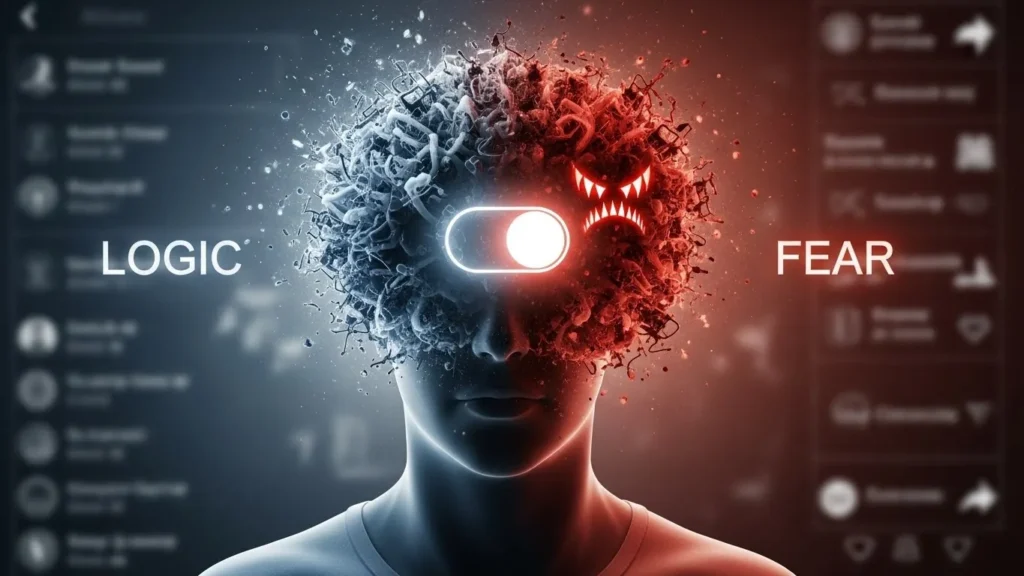
- The prefrontal cortex (logic center) loses influence
In simple terms:
Fear turns down reasoning and turns up reaction.
That’s why:
- You skip verification
- You ignore inconsistencies
- You act first and reflect later
This shift happens automatically.
You don’t choose it.
Why the Internet Is the Perfect Environment for Fear
Offline fear usually has context:
- Body language
- Physical surroundings
- Time to assess
Online fear is different.
It’s:
- Fast
- Isolated
- Context-free
- Hard to validate
A single message can create urgency without reality backing it up.
And urgency is fear’s favorite tool.
Fear-Based Messages All Sound the Same (For a Reason)
You’ve seen them:
- “Your account will be locked”
- “Unauthorized activity detected”
- “Payment failed — update now”
- “Legal action pending”
- “Security breach confirmed”
They trigger three things instantly:
- Loss avoidance
- Urgency
- Authority
Logic doesn’t disappear.
It gets outvoted.
Real-Life Example: The Calm Person Who Panicked
A financially savvy professional receives an email claiming a bank issue.
They know better.
They’ve warned others.
Still:
- The email feels urgent
- The brand looks familiar
- The risk feels immediate
They act.
Fear doesn’t target ignorance.
It targets attention under pressure.
Why Fear Beats Intelligence Online
Many people assume:
“Only uninformed users fall for this.”
That’s false.
Fear works because it bypasses knowledge.
Under fear:
- Smart people overestimate risk
- Experienced users trust shortcuts
- Confident users act faster
Fear doesn’t ask for permission.
It interrupts cognition.
The Fear–Logic Divide Explained Simply
| When Logic Is Active | When Fear Is Active |
|---|---|
| You evaluate evidence | You react to emotion |
| You verify sources | You trust authority |
| You notice inconsistencies | You miss red flags |
| You slow down | You rush |
| You think long-term | You act immediately |
Fear doesn’t make you wrong.
It makes you fast.
Why Fear Works Better Online Than Offline
Online environments remove grounding cues:
- No facial feedback
- No immediate social correction
- No shared reality check
You’re alone with the message.
Fear grows in isolation.
And digital platforms reward speed—not reflection.
The Most Dangerous Combination: Fear + Familiarity
Fear alone raises alertness.
Fear + familiarity lowers defenses.
When something:
- Looks official
- Sounds known
- Feels routine
Fear pushes you to act within a trusted frame.
That’s why impersonation scams are so effective.
Hidden Mistake People Make Under Fear
They try to resolve fear quickly instead of verifying calmly.
Fear wants relief.
Attackers promise it.
Clicking feels like solving the problem.
It rarely is.
Why This Matters Today (And Keeps Getting Worse)
Digital systems are becoming:
- Faster
- More automated
- More emotionally designed
Notifications, alerts, and warnings are everywhere.
As emotional stimuli increase,
rational processing gets crowded out.
This isn’t about technology failing.
It’s about human limits being pushed.
How to Break Fear’s Control Without Ignoring Risk
You don’t suppress fear.
You delay obedience to it.
Practical, Proven Techniques:
- Name the emotion
“This feels urgent” creates distance. - Delay action by 60 seconds
Fear weakens quickly without reinforcement. - Change the channel
Verify through a separate app or device. - Look for forced urgency
Real institutions rarely demand instant action. - Ask one logical question
“What evidence supports this?”
What Not to Do When Fear Hits
- Don’t rush to “fix”
- Don’t click embedded links
- Don’t assume legitimacy equals safety
- Don’t shame yourself for reacting
Fear is automatic.
Control comes after awareness.
The Safer Mental Rule to Adopt
Replace:
“I must act now.”
With:
“Urgency deserves verification.”
That single rule blocks most fear-based manipulation.
Why Calm Is a Security Skill
Calm doesn’t mean careless.
It means cognitively available.
The calmer you stay:
- The more logic returns
- The more patterns you notice
- The less predictable you become
Attackers rely on emotional predictability.
Calm breaks that pattern.
Key Takeaways
- Fear temporarily suppresses logical reasoning
- Online environments amplify fear responses
- Urgency is the primary fear trigger
- Intelligence does not protect against emotional hijack
- Small delays restore rational thinking
- Awareness beats avoidance every time
Frequently Asked Questions (FAQs)
1. Why do fear-based scams work so consistently?
Because fear triggers automatic reactions before logic engages.
2. Can training eliminate fear responses online?
No. Training helps recognition, but emotional responses are biological.
3. Are calm people immune to fear manipulation?
No—but they recover logic faster.
4. Is fear always bad in online decisions?
No. Fear can signal risk—but it should prompt verification, not action.
5. How long does fear-driven thinking last?
Often seconds to minutes. Delaying action is usually enough.
Conclusion: Fear Doesn’t Make You Irrational — It Makes You Human
Fear is not a flaw.
It’s a survival system operating in an environment it wasn’t designed for.
Online, fear doesn’t protect you.
It pressures you.
The goal isn’t to eliminate fear.
It’s to pause long enough for logic to return.
That pause is where control lives.
Disclaimer: This article is for general informational and educational purposes only and does not replace professional psychological or cybersecurity advice.

Natalia Lewandowska is a cybersecurity specialist who analyzes real-world cyber attacks, data breaches, and digital security failures. She explains complex threats in clear, practical language so everyday users can understand what really happened—and why it matters.
Pingback: How Authority Is Faked to Gain Trust — The Invisible Power Trick Used All Over the Internet
Pingback: Why Fear Is the Hacker’s Favorite Tool — How Panic Silences Logic Online